

AI EngineeringAI Product Engineering
AI That Ships Inside Your Product
LLM features, document intelligence, semantic search and voice — designed, built and put into production by engineers who have shipped all four.
Our engineers build AI features for products, from document processing and search to voice capabilities, and take them all the way into production.
Start with an AI Feature Sprint · 3 weeks · $20K–$35KTeams We've Built For








































- Valcre
Where You Start Depends on Where You Are
Most teams come to us at one of three points: before anything is built, after a prototype that works, or while waiting for a software vendor to add AI. What you need is different at each one, so start with the one that sounds like you.
You're about to build one
The model may answer using the wrong context, there's no test set to show whether results are improving, and costs that look fine during a pilot can become a problem at scale. Our AI Feature Sprint programme takes one feature into production with these issues addressed.
You've already started
Your prototype works, but retrieval may lack permission controls, costs may rise at real usage levels, and without a test set, you can't tell whether a provider change has affected results. Our Production Hardening Sprint programme addresses these issues, while a free Prototype Readiness Review helps determine whether your prototype can be hardened or needs a rebuild.
You're waiting for your software vendors
Their AI features work within their own systems. If that's all you need, waiting makes sense. But when a customer question spans three systems, you may need something that connects information across them. That's what we build, over your data and inside your product.
Building it properly the first time is faster than building it twice.
What We Do
Adding AI to your product takes more than connecting a model. Some of the work is what your users see, like search, document reading or a voice agent. The rest is the engineering underneath that keeps the answers right and the cost in check.
Already have a feature that's struggling in production?
Start with a different programme. The Production Hardening Sprint fixes those problems without rebuilding everything from scratch.
| Capability | What it covers | Where you start |
|---|---|---|
| Applied AI & LLM integration | Add Claude, Gemini or GPT to your product for search, recommendations, summaries, classification and content generation. Good for a long-planned feature that needs help reaching production. | AI Feature Sprint: 3 weeks, $20K–$35K. Production Hardening Sprint: 3–4 weeks, $25K–$45K. |
| Context engineering & RAG architecture | Design how information is retrieved and presented to the model: hybrid retrieval, re-ranking, chunking, indexing, context budgeting, memory and citations to sources. These choices decide answer quality. | Included in every engagement. It's part of building a reliable AI feature and isn't sold separately. |
| AI search & recommendations | Replace or improve keyword search with semantic and hybrid search, improve query understanding, measure relevance against your current system, and make enterprise information searchable within user permissions. | Search Modernisation Sprint: 3–4 weeks, $25K–$45K. |
| Document intelligence & extraction | Extract structured and unstructured information from PDFs, forms, contracts, scans and handwritten documents, with classification, validation and a common schema across 50+ document types. | Document Intelligence Sprint: 4 weeks, $30K–$45K. |
| Model customisation & cost engineering | Fine-tune with LoRA and QLoRA on open-weight models, adapt models to your domain, distill into smaller ones, route requests to the right model and manage inference cost as usage grows. | Scoped on the call. Usually the second engagement, once there's enough usage to show where the work will have the most impact. |
| Multi-modal AI | Features that work with images, video and audio as well as text: vision understanding, hard-to-process document layouts, video intelligence, audio analysis beyond speech and screen-aware assistance. | Scoped on the call, or included in a Feature Sprint. |
| Voice AI & conversational interfaces | Real-time speech-to-speech agents, contact-centre automation, outbound calls, voice-to-workflow connections and multilingual deployment. | Voice Agent Sprint: 2–3 weeks, $18K–$30K. |
What We Build On
When you're deciding who will build and maintain an AI feature, the specific tools matter, so we name them. We work with Claude, Gemini and OpenAI models, plus open-weight models where they make sense. We benchmark the options against your real use case and revisit the choice as we learn more about what the feature needs.
- Models
- Claude
- Gemini
- OpenAI models
- Models available through gateways such as OpenRouter
- Open-weight models where self-hosting is the right choice
- Orchestration
- LangChain
- LangGraph
- Claude Agent SDK
- MCP servers
- Retrieval
- Hybrid BM25 and dense vector search
- Cross-encoder re-ranking
- Graph RAG
- Vector stores on the client's existing data platform wherever possible
- Document processing
- AWS Textract
- Google Document AI
- Azure AI Document Intelligence
- An LLM layer on top, because OCR alone isn't enough for every document and extraction requirement
- Voice
- Real-time speech-to-speech
- ElevenLabs
- Deepgram
- AssemblyAI
- Google STT and TTS
- Observability and cost
- LangSmith
- Prompt and context version control
- Per-call cost tracking from the first week
- Platforms
- Amazon Bedrock
- Google Vertex AI
- Databricks
- Your cloud, your accounts
Partnerships and independence
We hold Google Cloud and AWS partnerships. We don't resell any model provider, so we can recommend a cheaper model when it's the right fit for the task.
What the Work Looks Like
Three projects from the services above, with the problem each one started from and what changed.
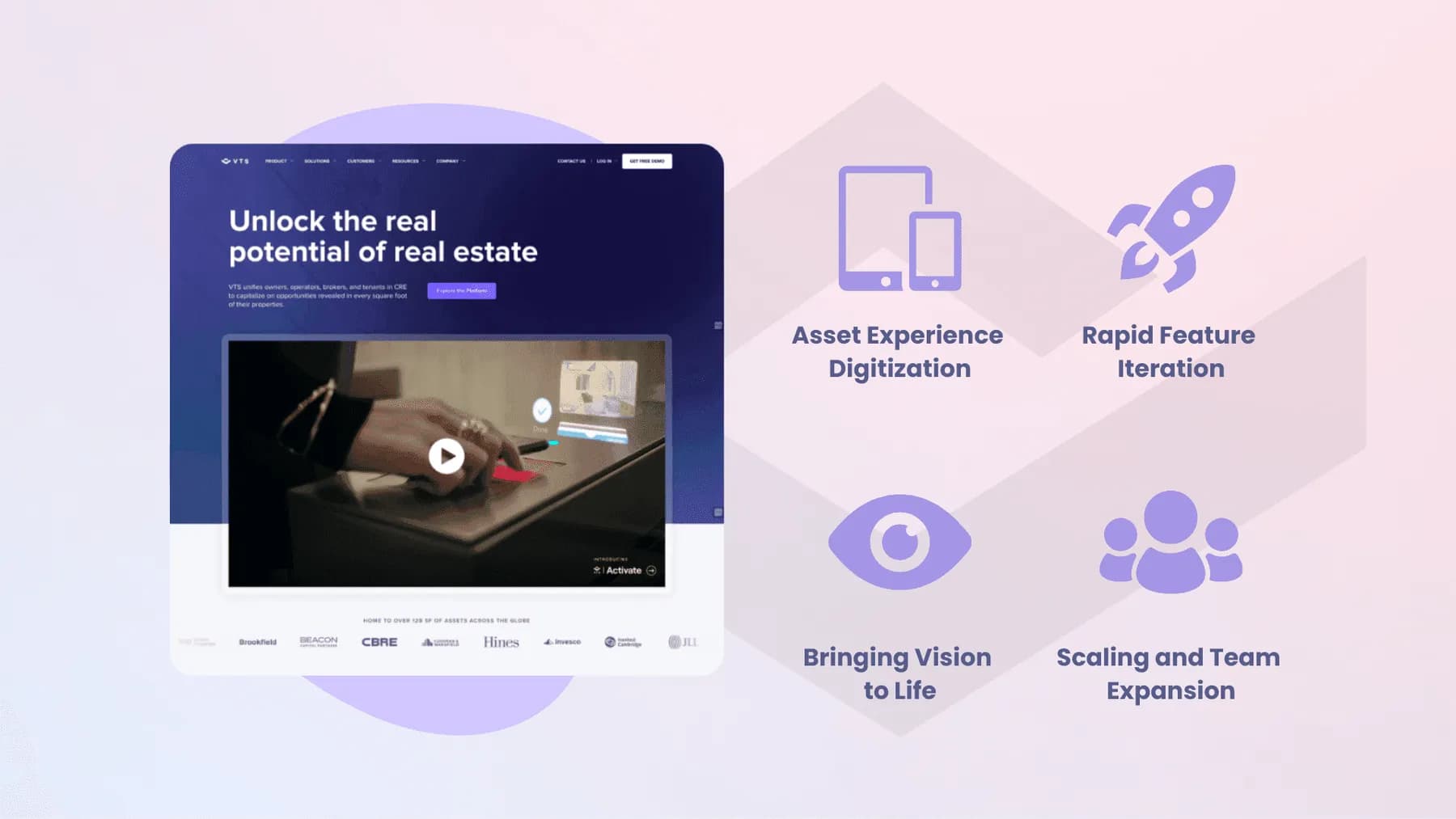 AI Engineering · United States
VTS
VTS Rise · Real Estate, PropTechVTS Rise is a property operations and tenant experience platform, that digitizes the entire asset experience, for landlords. It enables asset and property managers to power their portfolio-wide operations and provides a premium experience to residents, building operators, and visitors.Read the Full Case Study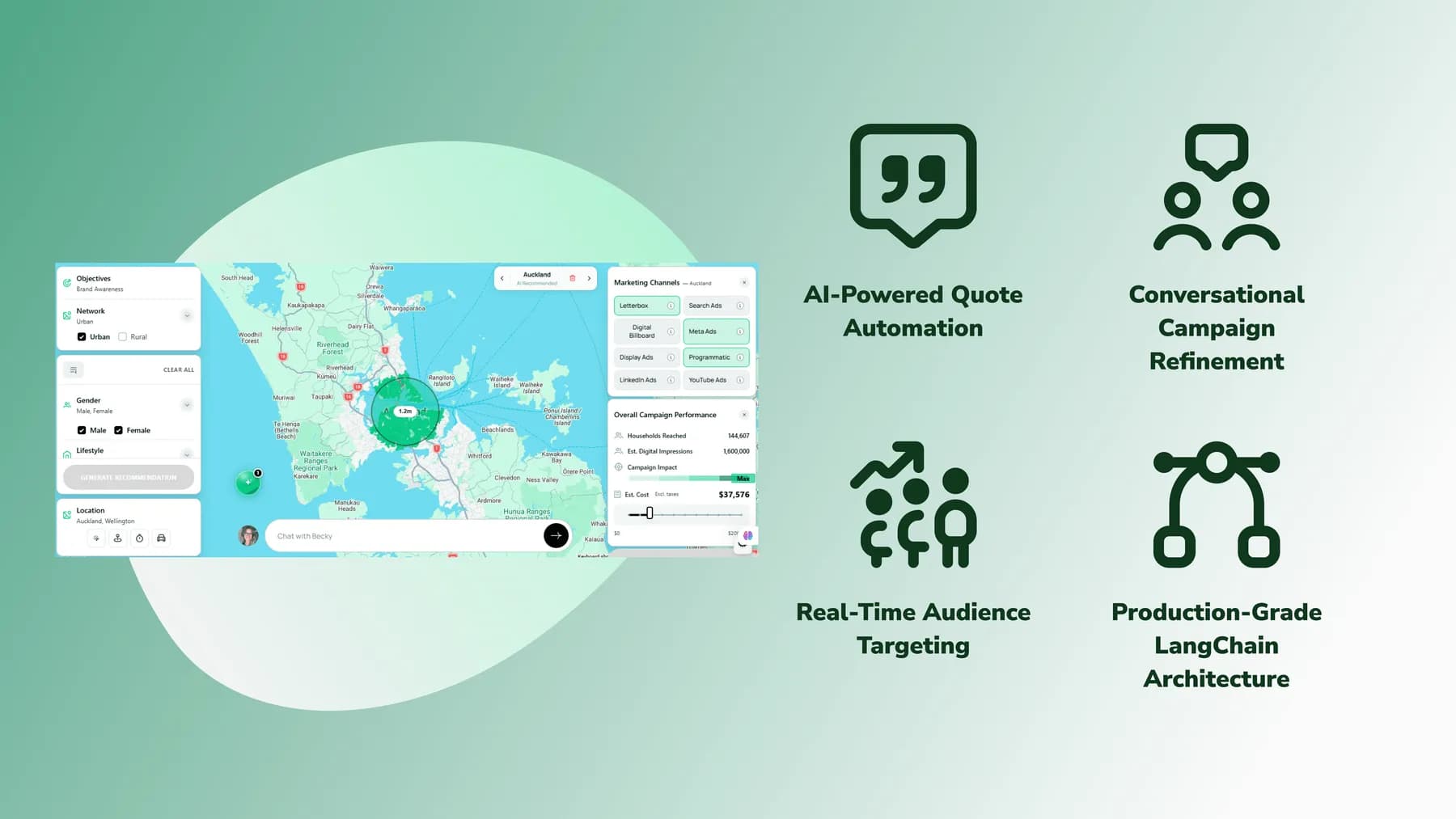 AI Engineering · New Zealand
Building an AI Agent for advertisement Targeting & Campaign Planning
AdvertisementWe built a system that combines a fast 5-step LangGraph pipeline with a real-time conversational agent to turn raw inputs into structured, cached recommendations and let users refine them via chat. It uses layered memory, tool-driven updates, and strong validation with caching to ensure reliable, efficient results.Read the Full Case Study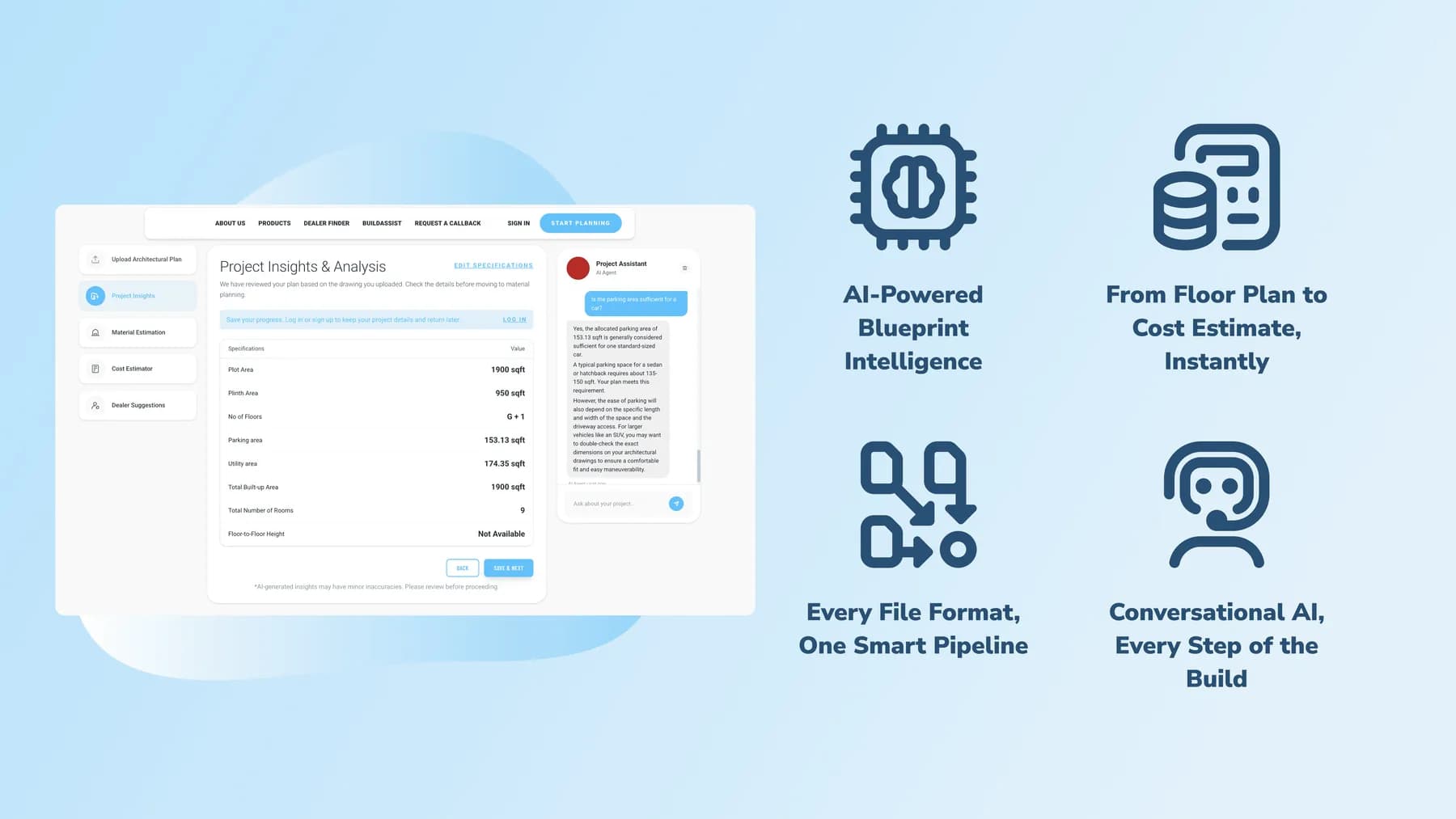 AI Engineering · India
HomeBuild Assist — AI-Powered Construction Planning Wizard
ConstructionWe built a self-serve planning and estimation system that turns architectural drawings into structured cost insights in minutes instead of days. It improves accuracy through multi-pass extraction and delivers city-specific material and labour estimates across 6 Indian cities. It seamlessly connects estimation to dealer discovery, with persistent projects you can resume anytime, anywhere.Read the Full Case Study
Where This Service Is Most Applied
We build AI features across industries, each with its own documents, terminology and risks. The work may differ from one industry to another, but the engineering behind it follows the same principles.

Financial Services
- AI underwriting Support
- Investment Research
- Contract Analysis and Filing Analysis

Healthcare
- Clinical Note Automation
- Patient Intake
- Medical Document Processing

Real Estate & PropTech
- Property Research
- Lease Document Analysis
- Tenant Experience

Insurance
- Policy Document Analysis
- Underwriting Support
- Voice-led policy Verification

Legal Tech
- Contract Review
- Due Diligence Automation
- Clause and Obligation Extraction
Fair Questions
For a lot of tasks, you should. The line is whether the AI needs to work over your data, inside your product, for your customers. A general assistant can’t see your documents, doesn’t know your schema and has no way to respect who’s allowed to see what. A vendor’s built-in AI can do all three, but only inside that vendor’s own boundary, and your customers’ questions often cross three systems at once. The parts that make an AI feature yours are the parts a general tool can’t do and a single vendor can’t reach. If you’re not sure which side of that line your idea falls on, BigStep’s free 90-minute session with a senior AI engineer will tell you, including when the answer is to use something off the shelf.
RAG is a way of having an AI feature look up the relevant passages from your own documents or data first, then hand them to the model along with the question, so the answer is based on your information instead of only what the model learned in training. An AI feature needs it whenever the answer depends on content the model has never seen, like your contracts, product documentation or customer records. The quality of the answers then depends less on the model and more on how retrieval is designed: how documents are split up, whether search combines keyword and semantic matching, how results are ranked and whether each answer cites its source passage. BigStep treats this as core engineering in every AI feature it builds, so context engineering and RAG architecture are included in each engagement and aren’t sold separately.
Prompt injection is when someone hides instructions inside content an AI feature reads, such as a document or an email, to make it misbehave. It matters most in the systems most worth building: an AI that reads your customers’ documents will eventually read one written to manipulate it. The defences are structural, not textual. Retrieved content is kept separate from instructions. The model’s available actions are limited to what the feature needs. Permissions are enforced at retrieval, so an injected instruction can’t reach data the user couldn’t open anyway. And any output that triggers an action is validated, not trusted. BigStep tests every AI system against this before it reaches production.
Running cost comes down to the cost of each call multiplied by how often the feature gets used, which is why a pilot that looked affordable can turn into a reason to limit usage once real volume arrives. The levers are prompt caching, context budgeting, controlling output length, semantic caching of repeated queries, and routing so cheap models handle easy requests and frontier models handle hard ones. Where volume justifies it, distilling a frontier model’s behaviour into a smaller open-weight model can cut cost several-fold on a well-scoped task. BigStep models the cost per call at your projected volume before anything is built and treats it as a design limit from the first week, so you have a cost-per-call figure before you have an invoice.
The model will change, and sooner than your roadmap assumes. Providers retire versions and update behaviour, sometimes without a version bump. The protection is the evaluation set built during the engagement: when a model changes, you re-run it and see what moved, instead of hearing about it from a customer. Nothing we build hard-codes one provider, and the model choice gets revisited, not assumed. It’s the main reason we build an evaluation set even on a three-week sprint.
Usually not. A prototype that retrieves the right answer most of the time has already solved the fun part. What’s left is the part that isn’t: a permission model built into retrieval and not bolted on after it, an evaluation set so a provider’s change is caught before a customer reports it, a cost per call that holds at real volume, and monitoring. That’s the Production Hardening Sprint, three to four weeks and $25K to $45K. If the prototype genuinely can’t be hardened, we’ll say so on the free review, not three weeks into a fixed-price engagement, and the honest answer then is an AI Feature Sprint instead.
Usually not at the start. Retrieval, prompting and a test set tend to come first, and fine-tuning is worth considering once real usage shows where it would help: a narrow task you run at high volume, a domain the base model handles poorly, or a cost you want to bring down by moving to a smaller model. The usual routes are LoRA and QLoRA on open-weight models, or distilling a larger model into a smaller one. BigStep treats model customisation and cost engineering as typically a second engagement, scoped once there’s enough usage to show where the work will have the most impact.
Pick the Feature. We'll Tell You What It Takes.
Ninety minutes with a senior AI engineer, on the feature you're actually trying to ship. You leave with three prioritised opportunities in your product, an effort and impact read on each, and an honest view of which one is worth doing first.
Already built something? Send it. In the same ninety minutes, a senior AI engineer will tell you what's likely to break it in production: retrieval and permissions, cost at real volume, and what happens when the model changes underneath it. You'll also hear whether you need us or just a fortnight. You get that in writing either way.