

AI Platforms & InfrastructureAI Infrastructure & LLMOps
Know What Your AI Costs and Where It Runs
Running AI costs money every time someone uses it, and most teams can't say what a thousand requests cost them. Some can't send their data to an outside AI provider at all. We find where the money goes and bring it down, and when your data has to stay home, we run the models inside your network.
Start with an Inference Cost Teardown · 2 weeks · $18K–$30KTeams We've Built For







































- Valcre
Where You Start Depends on Where You Are
Most teams come to us at one of three points: when they can’t say what a request costs, when their data can’t go to an outside provider, or when their product depends on a single provider. What you need is different at each one.
You don’t know what a request costs
Your AI bill may just be one number, you may not know which feature or customer is driving it, and a setup that looks fine in a pilot may be too expensive at real volume. Our Inference Cost Teardown programme breaks your token and GPU spend down by feature, customer and request, then prices three setups at your volume: your current stack tuned, a different mix of models, and self-hosting.
Your data can’t go to an outside provider
A regulator, a contract or a security team may require it to stay in your network, nobody may have worked out what can run where, and an open-weight model may never have been tried in your own cloud account. Our Sovereign AI Readiness Assessment programme works out what can run where, while our Private AI Deployment Sprint programme runs an open-weight model such as Llama, Qwen, DeepSeek or Mistral in your own cloud account.
You’ve built your product on one provider
A change to its price, speed or behaviour becomes a change to your product, you may have no second provider ready, and no way to release a model change gradually or roll it back. We route requests across models with a second provider ready, and our LLMOps Platform Launch programme versions every model and prompt so a change can be released gradually and rolled back.
Knowing what a request costs is the first step to bringing it down.
What We Do
Running AI well comes down to three questions: what each request costs, where the model is allowed to run, and how you change it without breaking it. Here's the work behind each one.
| Capability | What it covers | Where you start |
|---|---|---|
| Finding where the money goes | Break your token and GPU spend down by feature, customer and request, so you can see what a thousand requests cost you today. Then compare three setups at your volume: your current stack tuned, a different mix of models, and self-hosting. | Inference Cost Teardown: 2 weeks, $18K–$30K. |
| Running AI faster and for less | Tune how your models are served so the same hardware can often handle more requests, send each request to the cheapest model that can do the job, and switch to a second provider when the first one fails. | Scoped from the Inference Cost Teardown plan. |
| Open models you control | Deploy and tune an open-weight model such as Llama, Qwen, DeepSeek or Mistral, host it in your own cloud account, and measure its speed and cost against the hosted model you use today. | Private AI Deployment Sprint: 4 weeks, $40K–$70K. |
| AI inside your own network | Run AI where your data is allowed to be: your own cloud account, your data centre, or a network with no outside connection. That includes sizing the GPU servers and writing the evidence your security team will ask for. | Sovereign AI Readiness Assessment: 2–3 weeks, $22K–$40K. GPU Cluster Design Sprint: 3 weeks, $28K–$50K. |
| Changing models and prompts safely | Version every model and prompt, release a change to a few users first, test it on your own cases, and roll back to the last good version if it gets worse. We set up the cloud and DevOps underneath it too. | LLMOps Platform Launch: 6–10 weeks, $70K–$140K. |
| Image, video and audio generation | Build the production setup for generating images, video or audio, including training a model on your own brand and products, with the cost of each finished asset measured. | Generative Media Pipeline Sprint: 4–5 weeks, $35K–$60K. |
| AI on a phone or device | Run a model on the device itself, so it works offline, responds faster and keeps data off the network, where speed, cost or privacy call for it. | Scoped on the call. |
Our AI Infrastructure and LLMOps service covers AI costs and where it runs. Choosing a platform is AI Platform Partnerships & Professional Services, checking whether the quality holds is AI Quality Engineering & Evals, and the data your AI reads is Data Engineering for AI.
What We Build On
When you're deciding who will run your AI, the specific tools matter, so we name them. We work with open-weight and hosted models.
- Open-weight models
- Llama
- Qwen
- DeepSeek
- Mistral
- Hosted models to route between
- Claude
- Gemini
- OpenAI models
- Where it runs
- Your AWS or Google Cloud account
- Your private cloud or VPC
- Your own data centre
- Air-gapped networks
- What we set up around the model
- Model serving tuned for throughput
- Routing across models with a fallback provider
- A versioned registry of models and prompts
- Live evaluation
- Cost tracking per feature, customer and request
- Tracing and cost visibility
- LangSmith
- Langfuse
Partnerships
We hold Google Cloud and AWS partnerships. We don't resell any model provider, hardware or hosting, which is why we can tell you when a hosted API is cheaper than running your own.
What the Work Looks Like
Three projects from the services above, with the problem each one started from and what changed.
 AI Platforms & Infrastructure · New Zealand
Fine-Tuning a Sovereign LLM for an AI Agent Platform
Confidential ClientThe whole product ran on someone else’s frontier-model API, so a change in that provider’s price, speed or behaviour became a change in the product. We fine-tuned an open-weight model (Qwen3) and hosted it ourselves. Around it we set up a versioned model registry, a data flywheel that feeds real usage back into training, and live evaluation to show how each version performs.Read the Full Case Study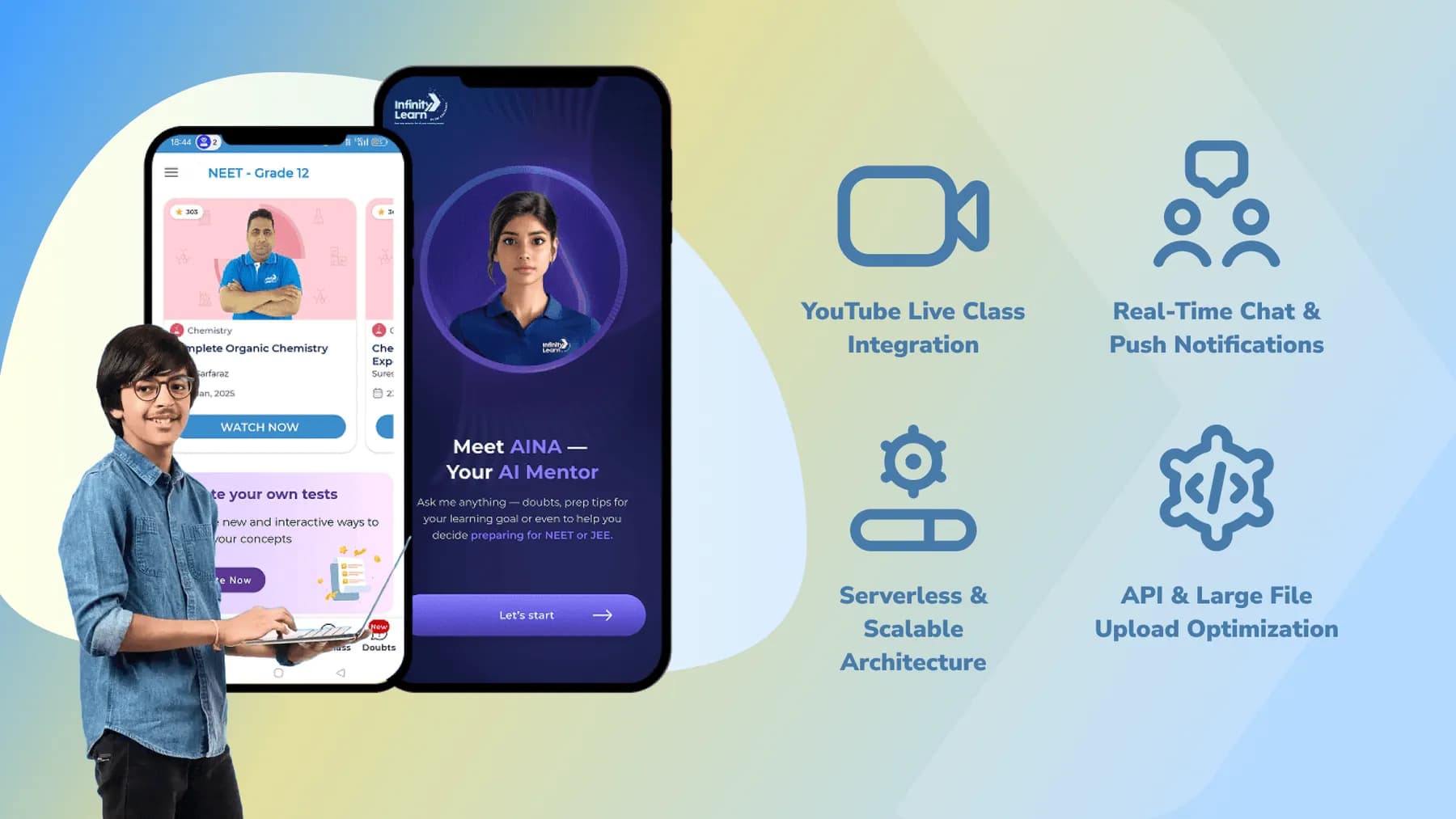 Software Engineering · India
Infinity Learn Live Learning Stack
Infinity Learn · EdTechWe built a scalable, serverless live learning infrastructure for Infinity Learn, enabling YouTube-powered live classes, real-time chat, and seamless notifications while optimizing costs and performance for millions of learners across India.Read the Full Case Study Software Engineering · India
Jio Media Stack
Jio · Digital CommunicationWe developed a bespoke Video Calling SDK for a leading communication technology client, eliminating third-party dependencies and enhancing control over their infrastructure in the digital communication industry.Read the Full Case Study
Where This Service Is Most Applied
We run and tune AI across industries, each with its own rules on where data can go and how big the bill can get. The setup differs from one industry to the next, but the engineering behind it follows the same principles.

Technology & AI Platforms
- Open-Weight Model Fine-Tuning
- Self-Hosted Model Serving
- Versioned Model Registry

Healthcare
- Private Open-Weight Deployment
- Air-Gapped Deployment
- Sovereign AI Readiness

Financial Services
- Sovereign AI Deployment
- Per-Customer AI Cost Tracking
- Multi-Model Routing

Retail, Commerce & Media
- Generative Media Pipelines
- Brand-Trained Image Models
- Response Caching
Fair Questions
LLMOps is the work of keeping a large language model reliable once people are using it. That means versioning the models and prompts, releasing changes gradually, rolling back a bad one, watching quality, and tracking what each request costs. MLOps does the same job for models you train yourself. LLMOps adds the parts that are particular to language models, such as prompts, hosted model providers and answers that differ from one run to the next. Our LLMOps Platform Launch (6 to 10 weeks, $70K to $140K) sets this up. We version every model and prompt, release a change to a few users first, test it on your own cases, and roll back to the last good version if it gets worse.
There’s no single number. It depends on the model, how long each request and answer are, and whether you pay a provider per token or run your own GPUs. The answer for your system comes from measuring three things: the tokens going in and out of each request, the price per token or per GPU hour, and how many requests you handle. If you’d like us to do the measuring, send us last month’s spend and our free Estimate My Run Cost comes back within three working days. For the full picture, our Inference Cost Teardown (2 weeks, $18K to $30K) breaks your token and GPU spend down by feature, customer and request.
Self-hosting usually starts to pay when your volume is high and steady, when most requests are simple enough for a smaller model, or when your data can’t leave your network. At low or uneven volume, a hosted API is often cheaper, because you pay for a GPU whether or not it’s busy. The crossover depends on your own volume and response-time target, so it has to be worked out from your numbers. Our Inference Cost Teardown does that by pricing three setups at your volume: your current stack tuned, a different mix of models, and self-hosting. We don’t resell models, hardware or hosting, so if a hosted API turns out to be cheaper, we’ll tell you.
An open-weight model is one whose trained weights are published, so you can download it and run it on your own hardware, as you can with Llama, Qwen, DeepSeek and Mistral. It isn’t always open source in the strict sense, because some come with licence terms about how you can use them. Open weights are what let you fine-tune a model on your own data and keep it inside your network. Our Private AI Deployment Sprint (4 weeks, $40K to $70K) deploys and tunes one of these models in your own cloud account and measures its speed and cost against the hosted model you use today. We check the publisher’s licence with you before choosing the model.
Yes. An open-weight model can run on your own servers, in your private cloud or on a network with no outside connection. The trade-offs are that you run and update it yourselves, the choice of models is narrower than a hosted API gives you, and you need the GPU hardware. Our Sovereign AI Readiness Assessment (2 to 3 weeks, $22K to $40K) works out what can run where and writes the evidence your security team will ask for. If you need your own hardware, our GPU Cluster Design Sprint (3 weeks, $28K to $50K) sizes the servers.
The biggest levers are caching answers to questions that repeat, sending each request to the cheapest model that can do the job, tuning how models are served so the same hardware handles more requests, and switching to a second provider when the first one fails. Which one matters most depends on where your spend actually sits, so measure it by feature, customer and request before changing anything. Our Inference Cost Teardown (2 weeks, $18K to $30K) does that, and the tuning and routing work is scoped from its plan. We’ve built caching around the questions that actually repeat in two of our agent systems, one for a market intelligence company and one for an advertising agency.
It depends on whether you need a cost review or a full platform. A review is a small fixed-price project, while a full LLMOps platform is a multi-week build. Our Inference Cost Teardown is $18K to $30K over 2 weeks, a Sovereign AI Readiness Assessment is $22K to $40K over 2 to 3 weeks, a Private AI Deployment Sprint is $40K to $70K over 4 weeks, and an LLMOps Platform Launch is $70K to $140K over 6 to 10 weeks. If you’re not sure which one you need, the free run-cost estimate or the Teardown shows you.
If your AI usage is small, your bill is steady and low, and your data is allowed to go to a hosted provider, you probably don’t. A hosted API is simple, and for many teams it stays the right choice. It’s worth looking again when the bill becomes a line someone asks about, when a compliance team says data can’t leave, or when a change at one provider would change your product. If you’re not sure which side you’re on, an Inference Cost Teardown will tell you. If your current setup is already the cheapest sensible one, that’s the answer.
Send Us Last Month's AI Bill and We'll Show You Where It Goes
Two weeks, a fixed price and a written plan that shows what your AI costs per feature, per customer and per request, and what three different setups would cost at your volume. If your current setup is already the cheapest sensible one, that's the answer. If you'd rather start smaller, the free run-cost estimate comes back in three working days.