

BigStep's AI Engineering practice builds AI systems and the evidence that they work. These three services share the same technical foundation and the same goal: putting AI into the products you sell, agents inside the work your business runs on, and the evaluation infrastructure that proves both are reliable. We build a working system in weeks rather than quarters, because shipping AI and proving AI are part of the same engineering problem.
What We Do
AI Product Engineering
AI that goes inside the product you sell to your customers.
Know More about AI Product EngineeringAgents & Agentic Workflows
AI that automates the work your own organisation performs.
Know More about Agents & Agentic WorkflowsAI Quality Engineering & Evals
The measurement, testing and guardrails that let you trust AI in production.
Know More about AI Quality Engineering & Evals
How do you know which service you need?
An AI copilot built into your SaaS product falls under AI Product Engineering, while a claims-processing agent running inside an insurance operation falls under Agents & Agentic Workflows. If the AI is already live and you are having trouble knowing whether it is actually working as expected, that is where AI Quality Engineering comes in.
Teams We've Built For








































- Valcre
You are probably here because one of these is true
We have promised an AI feature to our customers and the roadmap cannot absorb it.
Our team spends thousands of hours a month on work a machine should be doing.
Our AI is live, it is unreliable, and we cannot prove to our risk committee that it works.
We ran a pilot that demoed well and never reached production
Where this usually leads
These three services are connected by design. Each one builds on the previous, while giving your team more ownership along the way.
Every engagement has a clear endpoint, and what carries forward isn't our involvement but what your team is able to handle independently the next time.
A reliability engagement leaves you with a clear, actionable list of issues, and most clients fix the top findings themselves. The report is built for your engineers to use, not just by ours.
An agent prototype also needs a proper evaluation setup before it can move into production. We build that into the sprint from the start rather than treating it as something to add later.
And when an AI feature reaches customers, it needs guardrails that are yours, including your repository, CI, and defined thresholds.
How we work with your team
Named engineers
The engineers you meet are the engineers working on your build. Before you commit, you get their names and public work. Those are the same people you work with in week one and week twelve.
Real overlap
Our team works in your timezone, with the right team members available during your working hours. We work around your standups, sprint cycles, and tools.
Your repo from day one
Code goes into your repository, runs through your CI, and lives in your cloud environment, with your engineers reviewing it along the way. Nothing we build depends on a console we control, so you own the work from the first commit, not at handover.
Your code, your data
You own the code, prompts, evaluation sets, and model artefacts outright on payment. Your data stays in your environment unless you choose to move it, and we will sign your DPA.
How it ends
Every engagement has a clear exit, and we do not end the handover until your engineers understand how to run the system. You get a written runbook and a defect window after handover. If your team cannot run it without us, the work is not finished.
Rate your system in 60 minutes. For Free.
You decide and choose any one AI system you're already using — an agent, a search tool, a feature your customers touch every day and evaluate it in less than an hour. We check it across multiple areas and send you a written report on what's working well, what's at risk, and the three most important areas to fix first.
No strings attached
You don't need to prepare anything or hand over your data, and there's no obligation to hire us afterward. The report is yours either way, and it's written in a manner so that your own engineers can act on it right away.
Why bother
A lot of engineering leads run this themselves, then take the results straight to their CTO. That's smart, since you should know what's broken before anyone tries to sell you a fix.
What the Work Looks Like
Three projects from the services above, with the problem each one started from and what changed.
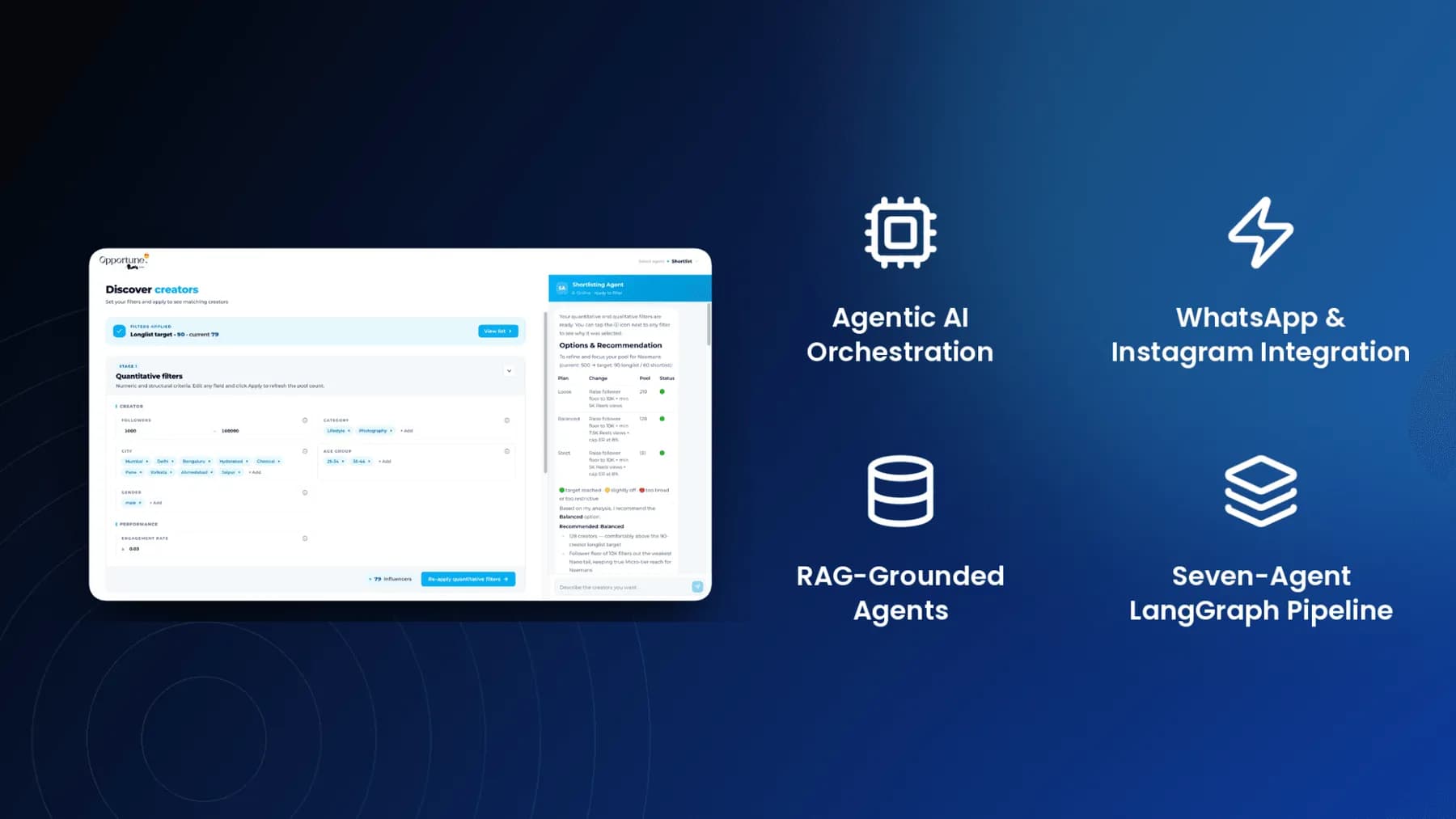 AI Engineering · India
WondrAgents - An AI-Powered Multi-Agent Platform for Influencer Marketing Operations
Opportune · Influencer Marketing / AdTechAn AI-powered platform that brings the entire influencer marketing lifecycle into one automated workflow, from creator discovery to campaign execution and evaluation.Read the Full Case Study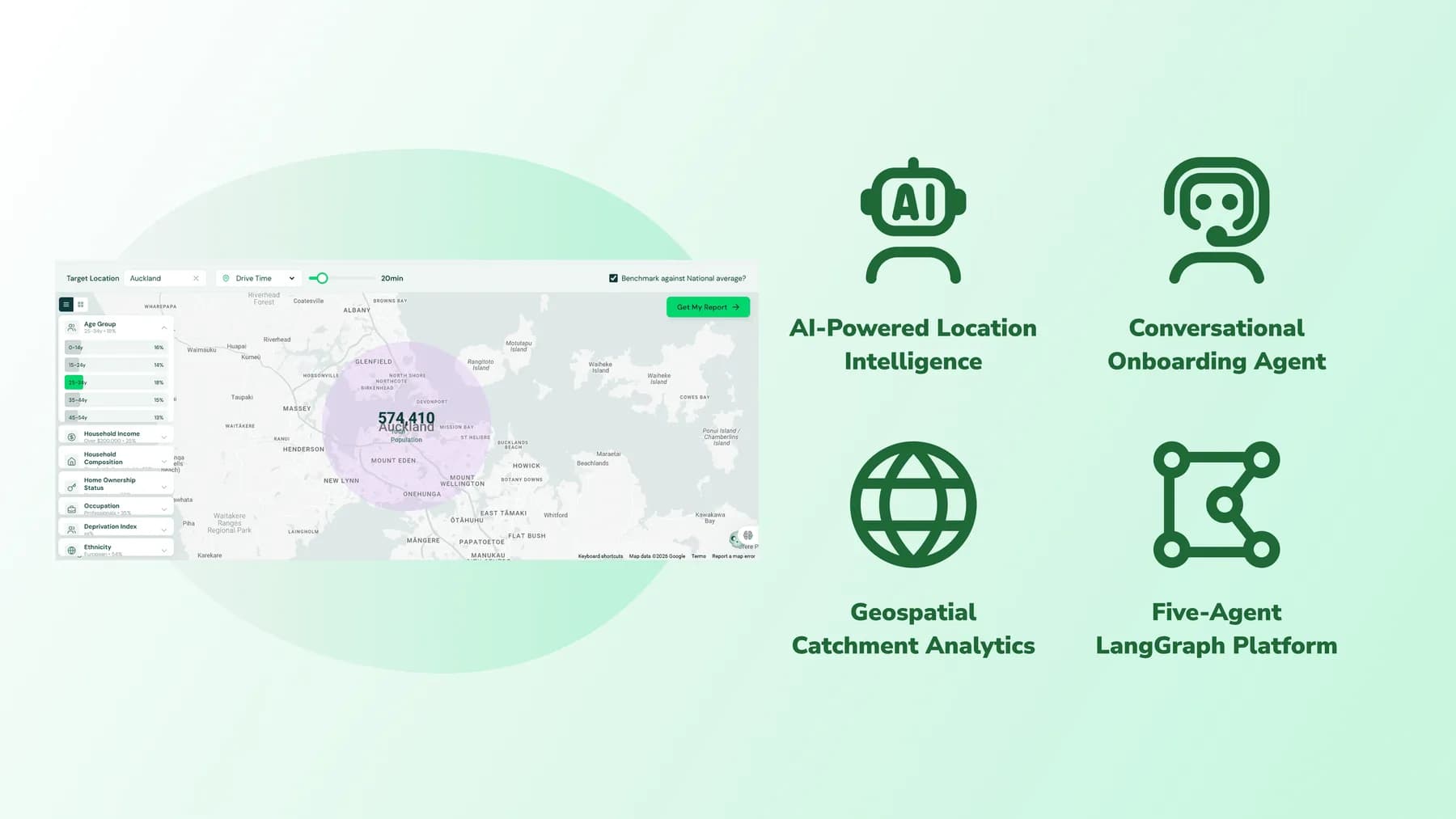 AI Engineering · New Zealand
A LangGraph Platform for AI-Powered Location Intelligence
MarketingWe built five production AI workflows on a unified LangGraph + Gemini stack, improving speed with early-return results and URL-level caching. The system supports resumable conversations, enforces governance within AI nodes, uses optimized multi-layer storage, and ensures reliability through schema-validated outputs—all accelerated by reusing Reach’s existing AI framework.Read the Full Case Study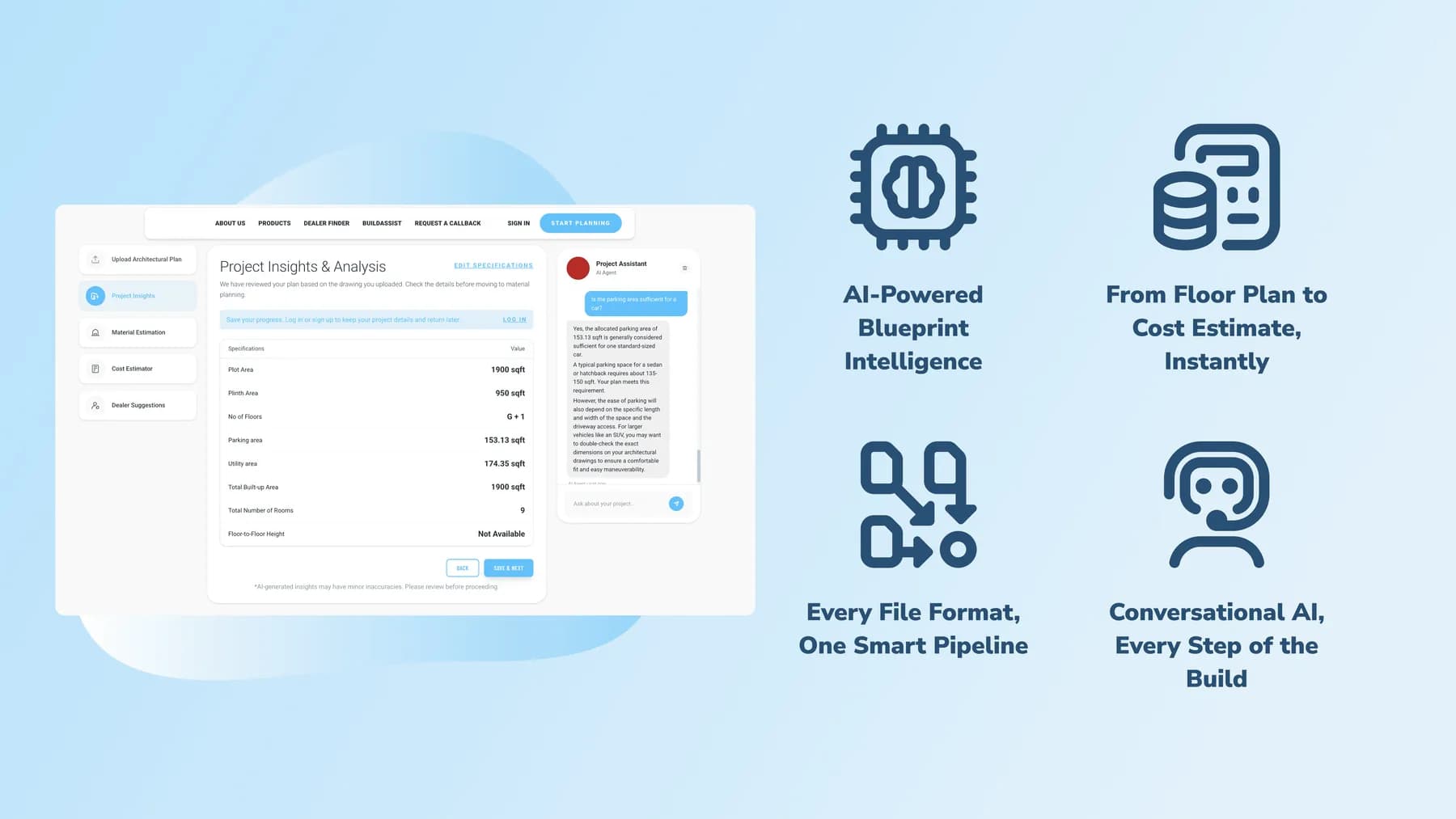 AI Engineering · India
HomeBuild Assist — AI-Powered Construction Planning Wizard
ConstructionWe built a self-serve planning and estimation system that turns architectural drawings into structured cost insights in minutes instead of days. It improves accuracy through multi-pass extraction and delivers city-specific material and labour estimates across 6 Indian cities. It seamlessly connects estimation to dealer discovery, with persistent projects you can resume anytime, anywhere.Read the Full Case Study
- LangGraph
- LangSmith
- Claude Agent SDK
- Amazon Bedrock
- Google Gemini
- Databricks
Fair questions
Book a Free SessionMost AI features move from a working prototype to production in a matter of weeks, not months, when the same team handles both stages without a handoff. BigStep Technologies typically gets a prototype ready in 1 to 2 weeks and a production version in 4 to 6 weeks, since fewer handoffs mean fewer places for scope to drift.
AI usually breaks in production because nobody tested how it behaves once real users, real data, and edge cases hit it, not because the underlying model was wrong. BigStep builds evaluation harnesses and guardrails specifically to catch this gap, treating it as a normal part of shipping AI rather than an afterthought.
An AI feature answers a question or completes one task inside a product, like a search bar or a chatbot. An AI agent carries out a multi-step piece of work on its own, like resolving a support ticket end to end or coordinating with other agents. BigStep builds both, along with the testing that keeps each one reliable.
You need a way to grade its output against a standard, try to break it on purpose, and keep checking it after launch instead of assuming it still works. BigStep runs a free Agent Reliability Scorecard that scores a live AI system or agent on exactly this, and flags specific gaps rather than a single grade.
Some AI agents can operate a company's existing software directly, clicking and typing the way a person would, without a custom integration built for every tool they touch. BigStep builds agents this way when it's faster than integrating, and wires in proper integrations when that's the more reliable route.
Certified partner status usually means direct, vetted access to a model provider's engineering resources and release roadmap, instead of going through a reseller who's reselling the same public API everyone else can call. In practice that tends to mean earlier access to new model releases, fewer integration surprises, and support from engineers who've actually shipped production systems on the platform rather than just read its documentation. BigStep holds certified partner status with both Anthropic and Google Cloud: on the Anthropic side, that's production experience with Claude Managed Agents, custom MCP integrations, and enterprise Claude Code rollouts; on Google Cloud, it's Vertex AI, Gemini, and Workspace AI, built by engineers who hold the certifications rather than just claim the relationship.
Let's have a conversation
Ninety minutes with a senior AI engineer and an architect, working on your actual problem. Not a discovery call, not a demo. You leave with three prioritised AI opportunities, an effort and impact read on each, and a two-page written summary — whether or not you ever engage us.