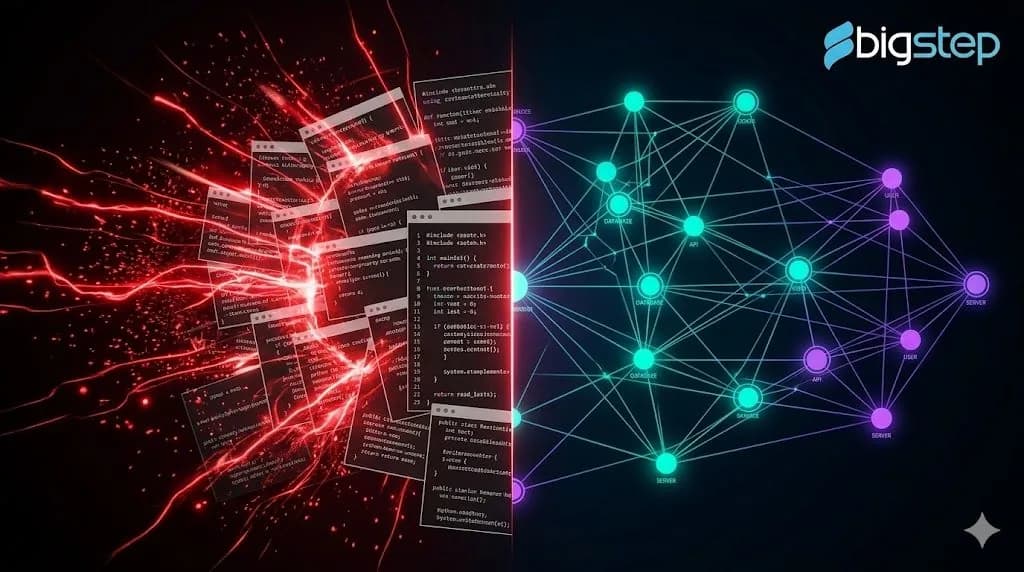

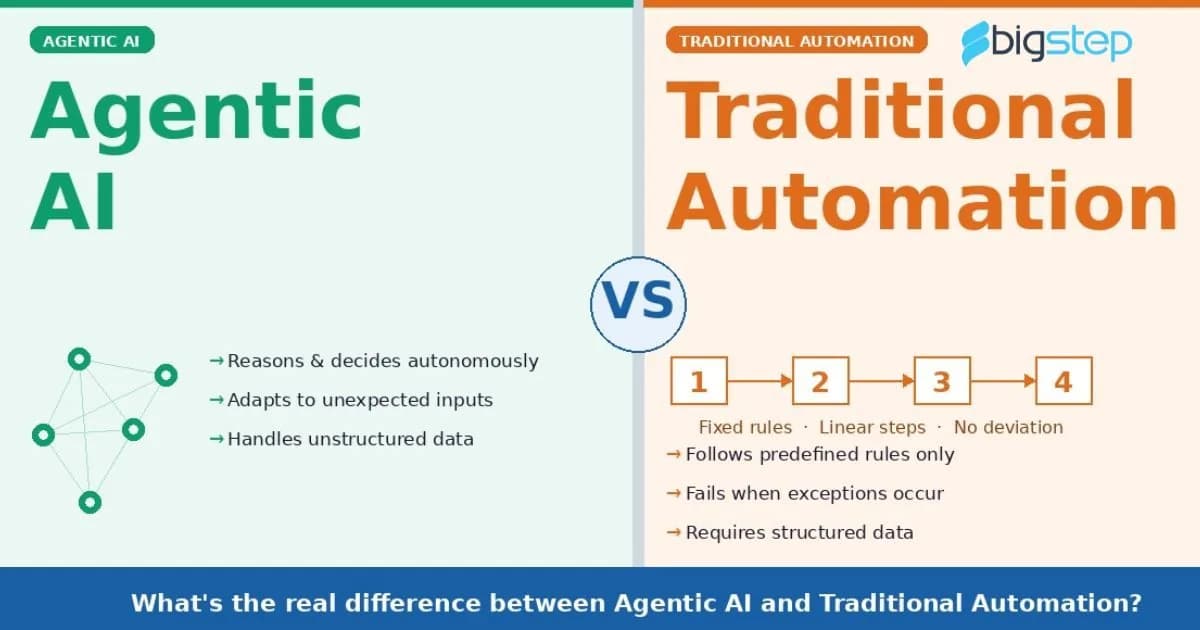
Team A built a rules-based automation system. It works, until a refund request arrives in the wrong language, flags an ambiguous reason code, or references a policy that changed last quarter. Then it breaks. A human steps in. Every time.
Team B deployed an Agentic AI powered automation workflow. It read the request, resolved the ambiguity, checked the updated policy, drafted a personalised reply and only escalated what genuinely needed a human. With context already prepared.
Same problem. Completely different outcome.
The gap isn’t speed. It’s intelligence. And if your automation can’t handle the real world only the idealised version you built it for you’re already paying for that gap. You just haven’t seen the invoice yet.
Here’s exactly where the line is drawn.
Defining the Terms: No Jargon, No Hype
What is traditional automation?
Traditional automation , often implemented through Robotic Process Automation (RPA) tools like UiPath, Automation Anywhere, or Blue Prism , executes predefined sequences of tasks based on explicit rules. It is deterministic: given the same input, it will always produce the same output.
It is exceptionally effective for structured, high-volume, repetitive tasks where the rules are stable and the data is consistent. Payroll processing, invoice extraction, form filling, data migration , these are the natural domain of traditional automation. The defining constraint: traditional automation cannot handle what it was not explicitly programmed to handle. It has no capacity for reasoning, judgment, or adaptation.
What is Agentic AI?
Agentic AI refers to AI systems , built on large language models (LLMs) and orchestration frameworks like LangChain, CrewAI, or AutoGen , that can autonomously plan, reason, use tools, and execute multi-step tasks to achieve a defined goal.
Unlike traditional automation, Agentic AI does not follow a fixed script. It interprets the goal, determines the steps required, uses available tools (search, APIs, databases, code execution), evaluates intermediate results, and adjusts its approach in real time.
The defining capability: Agentic AI systems can operate in environments they were not explicitly programmed for , handling ambiguity, incomplete data, and novel situations with a level of judgment that traditional automation fundamentally cannot replicate.
Head-to-Head: 6 Critical Dimensions: Agentic AI vs Traditional Automation
The table below compares Agentic AI and traditional automation across the dimensions that matter most to enterprise architecture and operations decisions.
Where Each One Belongs in Your Enterprise Stack
The most dangerous mistake in enterprise AI strategy is treating Agentic AI and traditional automation as competing solutions. They are not. They are complementary layers of an intelligent operations architecture, each suited to a distinct class of problem.
Deploy traditional automation when:
- The process is stable, well-defined, and unlikely to change frequently
- Data inputs are structured and consistently formatted
- Speed and volume are the primary drivers, not judgment
- Audit trails and deterministic outputs are regulatory requirements
- Examples: payroll processing, invoice data extraction, ERP data entry, compliance reporting, legacy system integration.
Deploy Agentic AI when:
_ The task involves ambiguity, judgment, or variable inputs
- Multiple tools, data sources, or systems need to be orchestrated
- The process requires reasoning across unstructured information (emails, documents, support tickets)
- The goal changes dynamically based on intermediate results
- Examples: customer support triage, sales intelligence workflows, contract review, research synthesis, dynamic pricing analysis, incident response.
The Hybrid Reality: How They Work Together
The most sophisticated Enterprise AI architectures in 2025 are not choosing between Agentic AI powered automation and traditional automation. They are layering them deliberately.
A common pattern: traditional RPA handles the structured data extraction layer , pulling information from legacy systems, PDFs, or databases. That structured output is then passed to an Agentic AI layer, which applies reasoning to make decisions, draft responses, or route exceptions. The result is a system that combines the speed and reliability of automation with the judgment and adaptability of agentic AI.
A real-world example: enterprise claims processing
- RPA extracts claim data from submitted PDFs and populates a structured database
- An AI Agent reviews the claim, cross-references policy documentation, assesses validity, and flags anomalies
- Straightforward claims are processed and responded to autonomously
- Complex or ambiguous claims are escalated to a human adjuster with a full AI-generated summary
- This hybrid approach reduces claim processing time by an order of magnitude while maintaining the human oversight that high-stakes decisions require. Neither technology alone would achieve both outcomes.
The Risks No One Talks About
Both technologies carry risks that are frequently underestimated in vendor evaluations and executive briefings.
Traditional Automation risks
- Brittleness: Any change to the underlying system , a UI update, a field rename, a process change , breaks the automation. Maintenance costs compound over time.
- Technical debt: Large RPA estates become extraordinarily difficult to manage, audit, and update. Organisations frequently find themselves maintaining hundreds of fragile bots with no clear ownership.
- False ceiling: Teams optimize for what automation can do, rather than what the business actually needs. The result: processes redesigned around the tool’s limitations rather than business value.
Agentic AI risks
- Hallucination and errors: Agentic systems can reason incorrectly. Without structured output validation at every LLM boundary, errors propagate downstream undetected.
- Governance gaps: Autonomous systems acting across multiple tools and data sources create audit and compliance challenges that most organisations are not yet equipped to manage.
- Scope creep: Agentic systems given broad access and poorly defined objectives can take unintended actions. Clear boundaries, human-in-the-loop checkpoints, and robust monitoring are non-negotiable.
How to Make the Right Decision for Your Organisation
The right question is not “Should we use agentic AI or traditional automation?” The right question is: “What class of problem are we solving, and what is the cost of getting the architecture wrong?” A practical decision framework:
- Map your process: Is it structured or unstructured? Stable or variable? Rules-based or judgment-intensive?
- Assess the cost of failure: What happens when the system encounters an exception? Can the business tolerate a deterministic failure, or does it need adaptive recovery?
- Evaluate the maintenance horizon: How frequently does the underlying process change? - - High-change environments favour agentic AI. Stable environments favour RPA.
Consider the hybrid architecture: For most enterprise workflows of meaningful complexity, the answer will be a deliberate combination of both , not a binary choice.
The Bottom Line: Agentic AI vs Traditional Automation
Agentic AI and traditional automation are not competing technologies. They are different instruments in an intelligent operations architecture , each with a distinct role, a distinct risk profile, and a distinct return on investment.
The organisations building durable competitive advantage in 2025 are not the ones that deployed the most automation, or the ones that rushed to agentic AI. They are the ones that understood the difference, designed the architecture deliberately, and built systems governed well enough to scale.
Making that distinction , and getting the architecture right , is exactly what BigStep Technologies is built to help you do.