
On one side: founders still pitching per-seat SaaS, dashboards, and feature roadmaps.
On the other: a quieter, faster-moving cohort building AI-native systems that reason, retrieve, orchestrate, and execute on behalf of the business.
The first group is optimizing for renewals. The second is rewriting how enterprise software is built, sold, and consumed.
At BigStep Technologies, we sit on the engineering side of this divide. As an AI consulting company, we help enterprises ship AI-driven software, agentic workflows, and production AI systems that produce real outcomes — not demos.
🚀Curious what production agents actually look like? See how we built a multi-agent platform→
The Great Divide: Per-Seat SaaS vs. AI-Native Systems
The most repeated phrase at SaaStr Day 1 was some version of: “The seat is dying.” That is not hyperbole. When intelligent agents can perform the role a human used to log in to perform, the seat ceases to be the unit of value. Outcomes do.
Tom Occhino’s data point was the moment the room went silent: 30% of all Vercel deployments are now initiated by AI agents, a 1,000% increase in six months.
Agents are now writing software, deploying software, and — increasingly — creating more agents. This is recursive automation in the wild, and it is happening in production at one of the most engineering-mature platforms in the industry.
That signal matters far beyond Vercel. It tells enterprise leaders three things:
- AI-native engineering is no longer an experiment; it is a deployment pattern.
- Agent-to-agent systems are becoming the new substrate of software delivery.
- The companies that win the next decade will treat agents as first-class users of their internal systems.
Why Most Vertical SaaS Will Quietly Disappear
In his fireside with Jason Lemkin, Amjad Masad shared that SaaStr itself replaced its sales team with 20 AI agents.
His prediction was sharper: most vertical SaaS products will not survive the agentic transition. The applications that endure will be systems of record — the databases, ledgers, CRMs, and operational stores that agents need read/write access to in order to act.
The logic is straightforward. If an agent can read your CRM, draft the outreach, run the call, log the disposition, and update the pipeline, the “sales workflow tool” sitting between the human and the system of record is redundant. The interface layer collapses. What remains is data, decisions, and the agent fabric in between.
For enterprise leaders, this is not a five-year forecast. It is a 12-to-24 month restructuring of the software stack. BigStep is already executing enterprise AI implementation engagements where we replace seat-licensed point tools with agentic workflows that plug directly into Salesforce, NetSuite, Jira, and proprietary systems of record — and report results in tickets resolved, deals closed, and dollars recovered.
The 90% Nobody Talks About: Production AI Engineering
Sherif Mansour’s line at LangChain Annual captured what every serious AI practitioner already knows: “The model is 10% of the work. 90% is everything around it.”
The 90% is where AI projects live or die — and where most in-house teams stall. It includes: Orchestration: routing tasks across models, tools, and agents deterministically.
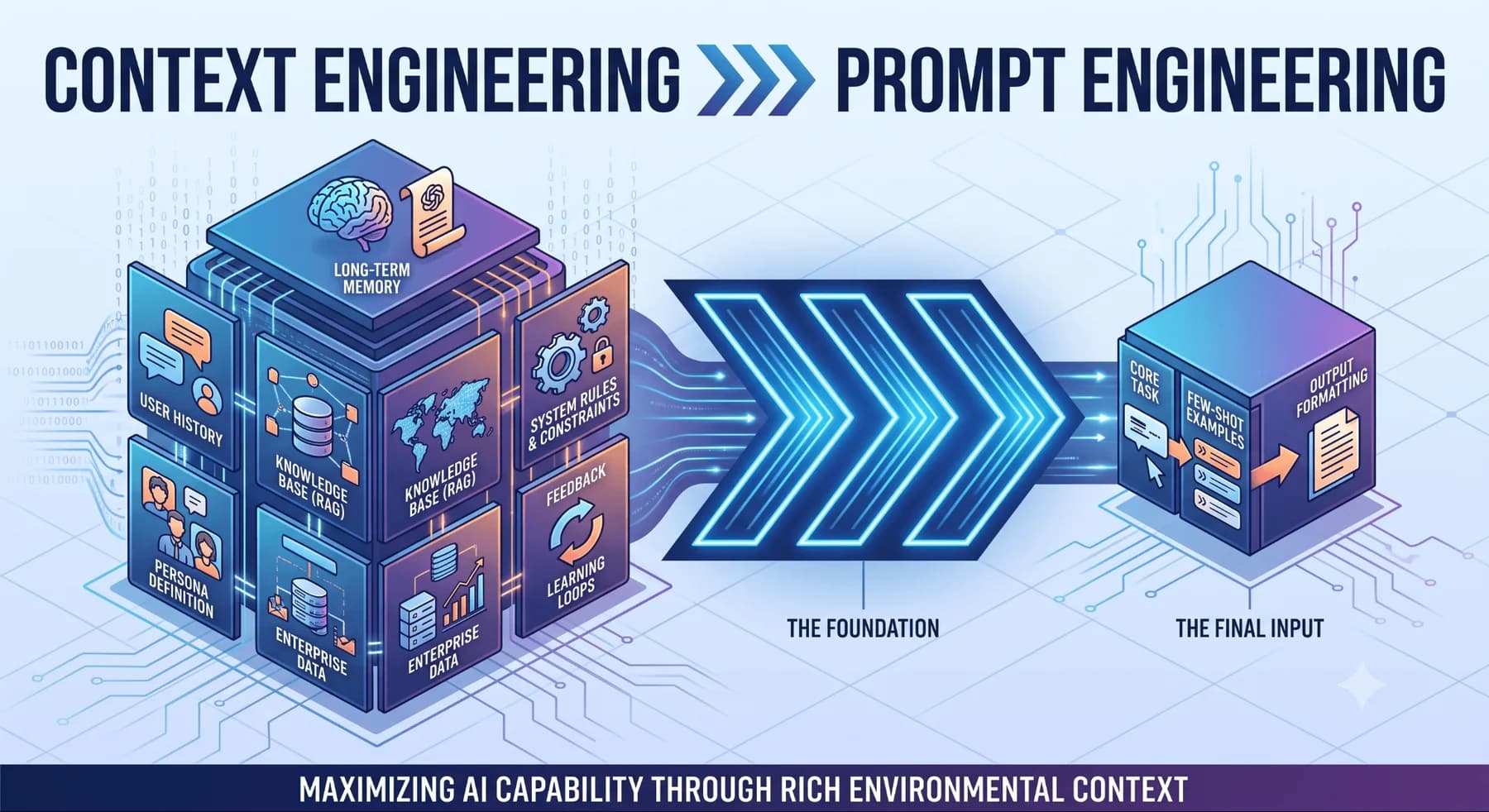
Retrieval: building enterprise-grade RAG pipelines with high recall and low hallucination.
- Evaluation: continuous, automated quality measurement against business KPIs.
- Observability: tracing every agent decision, tool call, and token cost.
- Security and governance: role-based access, data residency, audit trails, model risk management.
- Integrations: deep, reliable connectivity to the systems agents must read and write.
- Workflow reliability: retries, fallbacks, human-in-the-loop gates, idempotency.
This is the work BigStep specializes in. As an AI consulting company built on production engineering, we treat AI as a distributed systems problem first and a model problem second.
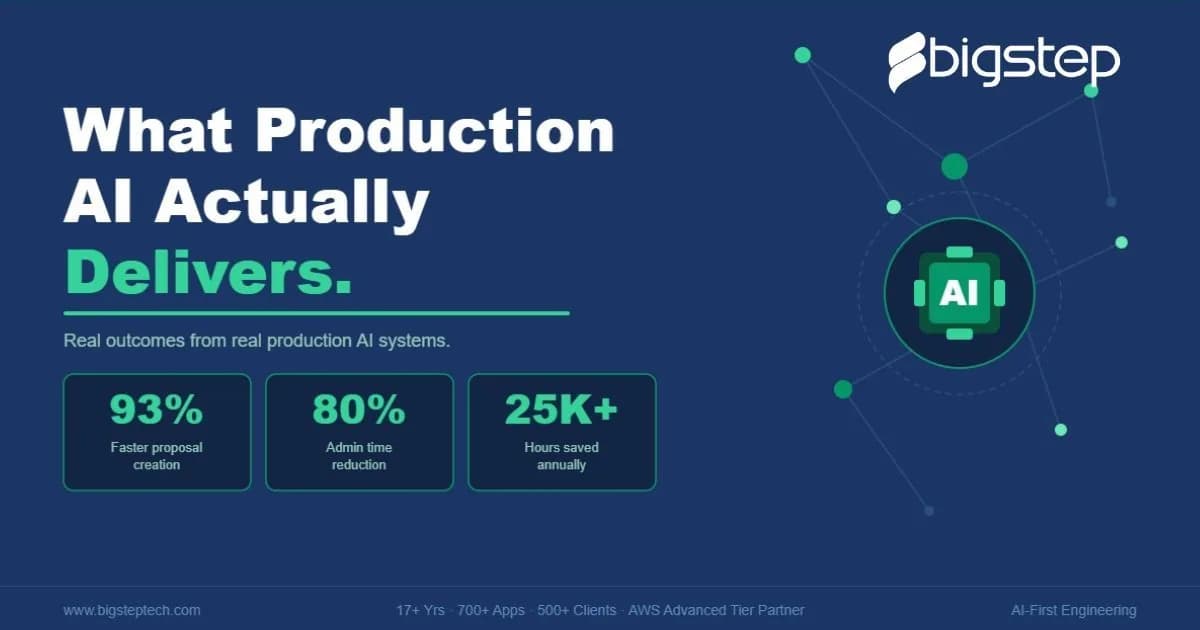
🚀Want proof? Explore real enterprise outcomes in our case studies
From Per-Seat Pricing to Outcome-Based AI
The pricing shift discussed across SaaStr 2026 is the commercial expression of the technical shift. Enterprises are no longer comfortable paying per seat for software a human may or may not log into. They are paying for outcomes: per deal closed, per ticket resolved, per invoice processed, per workflow completed end-to-end, per dollar of cost recovered.
This forces vendors — and internal AI teams — to engineer for measurable business impact. It also creates a new class of risk: an AI system that cannot prove its outcome cannot be priced. Evaluation, observability, and ROI instrumentation are no longer optional. They are commercial infrastructure.
BigStep designs AI solutions where outcome metrics are wired in from day one. Every agent we ship reports against the KPI it was built to move. That is what makes outcome-based pricing — and outcome-based budgeting — viable inside the enterprise.
What an AI-Native Enterprise Actually Looks Like
- Strip away the buzzwords and an AI-native enterprise has five engineering properties:
- A unified retrieval layer over structured and unstructured data, governed and access-controlled.
- An agent fabric with orchestration, memory, and tool use across departments.
- Composable workflows that humans and agents can both invoke and modify.
- Continuous evaluation tied to business KPIs, not model benchmarks.
- Systems of record are treated as first-class APIs for agents, not just UIs for humans.
- Enterprises that build these foundations stop launching one-off “AI features” and start compounding capability. Every new agent inherits the same retrieval, orchestration, governance, and evaluation backbone. That is how production AI scales.
🚀See the AI-powered construction planning wizard in action →
Enterprise Pain Points We See Every Week
Across our engagements as an AI consulting company, the recurring blockers are remarkably consistent:
- Prototypes that demo brilliantly but fail under real data volume.
- Hallucinations in customer-facing flows because retrieval was bolted on, not architected.
- Agents that cannot reliably call internal APIs because the APIs were never designed for non-human consumers.
- No evaluation harness, so quality regressions ship silently.
- Security and compliance teams blocking rollouts because governance was an afterthought.
- None of these are model problems. All of them are engineering problems. They are exactly the problems a production-grade AI consulting company is built to solve.
Implementation Recommendations for 2026
- For CTOs, Chief AI Officers, and innovation leaders planning the next 12 months, BigStep’s practitioner guidance is direct:
- Pick outcomes, not features. Anchor every AI initiative to a measurable business KPI before writing a prompt.
- Invest in the 90%. Budget orchestration, retrieval, evaluation, and observability as core platform spend.
- Treat agents as users. Audit your APIs, permissions, and audit logs for agent-grade access.
- Replace, do not augment. Where workflows are mature and rules-bound, replace seat-licensed tools with agentic equivalents.
- Build a thin AI platform, not silos. A shared agent fabric beats ten disconnected copilots.
- Partner where the depth matters. Production AI is a specialized discipline; the cost of getting orchestration and governance wrong is far higher than the cost of expert help.
Why Enterprises Choose BigStep as Their AI Consulting Company
Three reasons come up again and again.
- We are practitioners, not theorists. Our engineers ship agentic workflows to production every week. We know what breaks at scale because we have fixed it.
- We design for outcomes, not features. Every system we deliver is wired to a measurable KPI — resolution rate, cycle time, conversion, cost recovered.
- We own the full stack of production AI. Strategy, architecture, agent development, retrieval, orchestration, observability, governance, integrations. One partner. One throat to choke. One AI roadmap that actually ships.
Ready to move from AI pilots to production outcomes? Talk to BigStep’s AI engineering team
The Enterprise Pain Points We Solve
When enterprises bring us in as their AI consulting company, the recurring blockers look like this:
- Prototypes that demo well but collapse under real data volume.
- Hallucinations in customer-facing flows because retrieval was an afterthought.
- Agents that cannot reliably call internal APIs that were never designed for non-human users.
- No evaluation harness, so quality regressions ship silently.
- Security and compliance teams blocking rollouts because governance came last.
None of these are model problems. All of them are engineering problems. All of them are solvable.
FAQ Section
Q1. What is an AI-native enterprise? An AI-native enterprise is an organization whose core workflows are executed by AI agents on top of a unified retrieval layer, governed integrations, and outcome-based evaluation — rather than by humans operating seat-licensed SaaS tools.
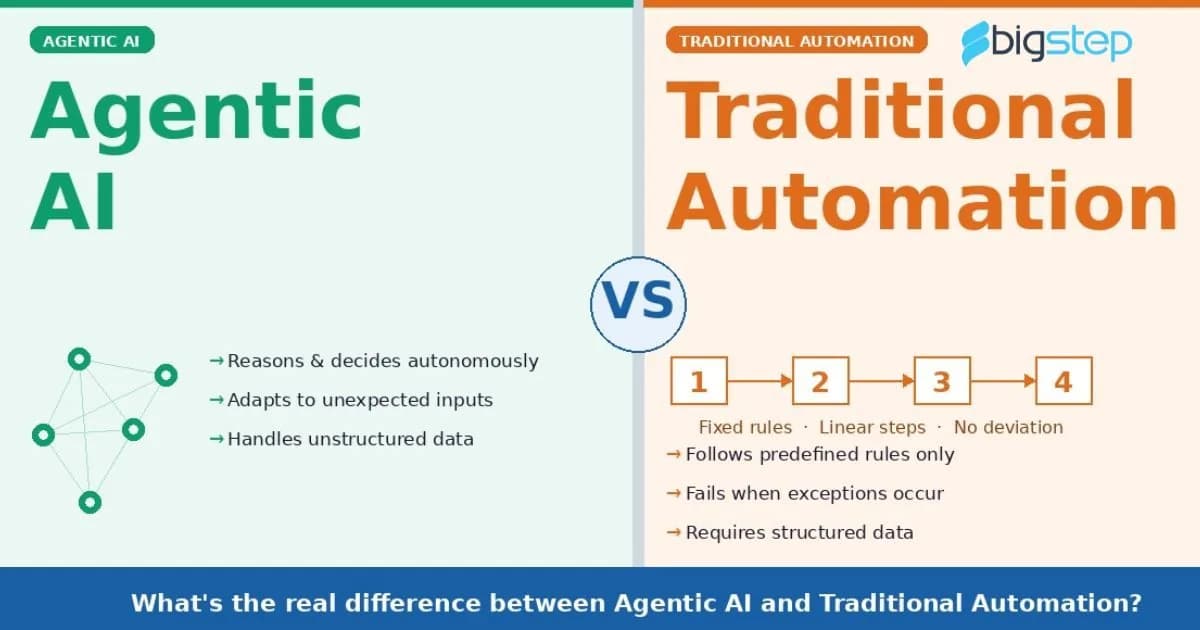
Q2. How are agentic workflows different from traditional automation? Traditional automation follows fixed rules. Agentic workflows reason over context, retrieve relevant information, choose tools dynamically, take action across systems, and adapt to changing inputs — all with human-in-the-loop controls where required.
Q3. Why is per-seat SaaS being replaced by AI agents? Because outcomes, not logins, are what enterprises actually buy. When an agent can perform the work a human used to perform inside a tool, the seat — and often the tool itself — becomes redundant.
Q4. What does “the model is 10% of the work” mean for enterprises? It means that real production AI value comes from orchestration, retrieval, evaluation, observability, security, governance, and integrations. The foundation model is a commodity input; the engineering around it is the moat.
Q5. How does BigStep help with enterprise AI implementation? BigStep is the AI consulting company that delivers end-to-end AI implementation — strategy, architecture, agent development, retrieval engineering, orchestration, observability, security, and outcome instrumentation — so AI systems ship to production and produce measurable business results.
Q6. What ROI should enterprises expect from agentic workflows? ROI is measured directly in outcomes: tickets resolved, deals closed, workflows automated, cost recovered. Properly engineered agentic workflows typically pay back within one to two quarters in high-volume operational domains.