
The Inflection Point Every Enterprise Hits
Eighteen months into running multiple AI initiatives, every enterprise we work with hits the same wall.
The marketing team’s copilot. The operations workflow agent. The customer-support summarizer. The embedded reasoning feature. Each was built by a different team on a slightly different stack.
For a while, this is fine. Then a regulatory question lands and three teams discover their audit trails are inconsistent. A model deprecation forces three separate migrations. A cost spike traces back to a team that never instrumented tokens. A new feature needs to share state across two agents — and the memory layers don’t speak the same language.
🔍What can multiple AI agents achieve together? This might surprise you:_
This is the enterprise AI agent platform inflection point. The question shifts from “should we build an agent?” to “how do we build a platform that supports many agents, many teams, and many product surfaces without each one reinventing the stack?”
What You’ll Get From This Article
- Why LangGraph belongs as a platform primitive, not a library import
- A reference architecture for enterprise agentic AI (eight components)
- Cost discipline patterns that compound across an agent portfolio
- Governance and auditability foundations for regulated industries
- The architectural shift defining the next phase of agentic AI
LangGraph as a Platform Primitive, Not a Library
The most consequential architectural reframe at this stage is treating LangGraph as a platform primitive rather than as a per-project dependency.
The distinction is not semantic. It changes how ownership, deployment, and governance work across the organization.
What Changes When LangGraph Becomes Shared Infrastructure
This is the same maturation curve enterprises went through with databases, message queues, and container orchestration. Nobody builds those per-project anymore. Enterprise agentic AI is moving the same way — and the organizations that recognize this early gain a structural advantage.
A Reference Architecture for Enterprise Agentic AI
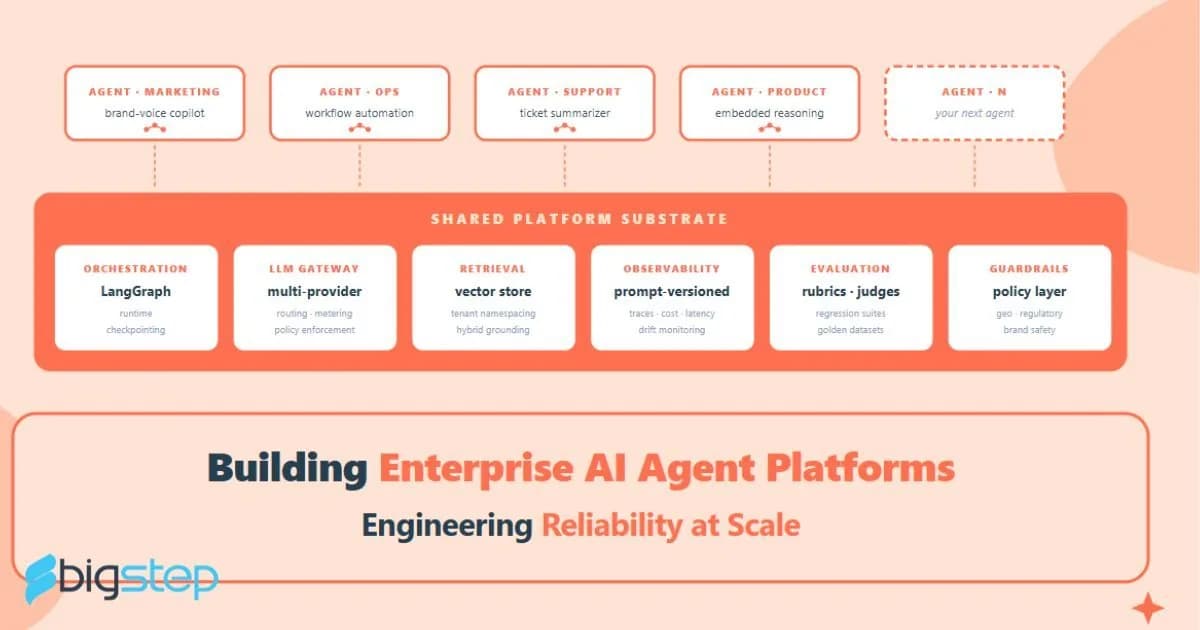
Eight components form the foundation of an enterprise AI agent platform. None is novel in isolation. The value comes from how they fit together.
- Orchestration runtime — LangGraph deployed as shared infrastructure
- Composition layer — LangChain used inside each node for prompts, tools, structured outputs
- LLM gateway — multi-provider routing, rate limiting, cost accounting, prompt-injection defense
- Retrieval substrate — vector store with strict tenant or business-unit namespacing
- State and checkpoint store — dedicated Postgres for LangGraph checkpoints
- Observability layer — prompt-versioned traces across every LLM call and graph invocation
- Evaluation harness — structured rubrics, LLM-as-judge frameworks, regression suites
- Guardrails policy layer — geographic, regulatory, brand-safety constraints applied uniformly
Each agent application sits on top of this shared substrate. The platform team standardizes the operational concerns. Product teams focus on the domain logic of their agents.
Cost Discipline That Compounds
Cost discipline at enterprise scale is rarely about clever tricks. It’s about applying a handful of patterns consistently across the entire agent portfolio:
- Idempotent recompute via hash lookup — never pay twice for the same input
- URL-level caching for deterministic scraping and API calls
- Per-node model routing — cheap models for classification, premium models for reasoning
- Structured-output discipline — never generate tokens you cannot consume
- Prompt versioning with cost tracking — catch drift before it inflates the bill
- Early-return with background enrichment — fast path now, deep analysis later
“None of these patterns are flashy. Together, they’re the difference between an agentic platform that scales economically and one that becomes a quarterly fire drill.”
🚀_Not all location data is equal—this case proves why
Governance, Auditability, and Regulatory Readiness
For enterprises in regulated industries — finance, healthcare, insurance, government — agentic systems live under the same governance regime as any other production system. Often more so.
The architectural foundation for governance is replayability. Every recommendation, every classification, every generated artifact must be reconstructable from a stored input plus a versioned prompt plus a versioned retrieval set. The audit question — ”why did the system recommend this?” — has a definitive technical answer.
This builds on the same primitives that make the system debuggable: immutable persistence keyed by input hash, prompt versioning, retrieval-set capture, end-to-end tracing. What changes at the governance layer is formalization. Retention policies are explicit. Access to traces is logged. Audit-packet retrieval procedures are documented and rehearsed.
Building these foundations early is dramatically easier than retrofitting them later.
Where Agentic Systems Are Going
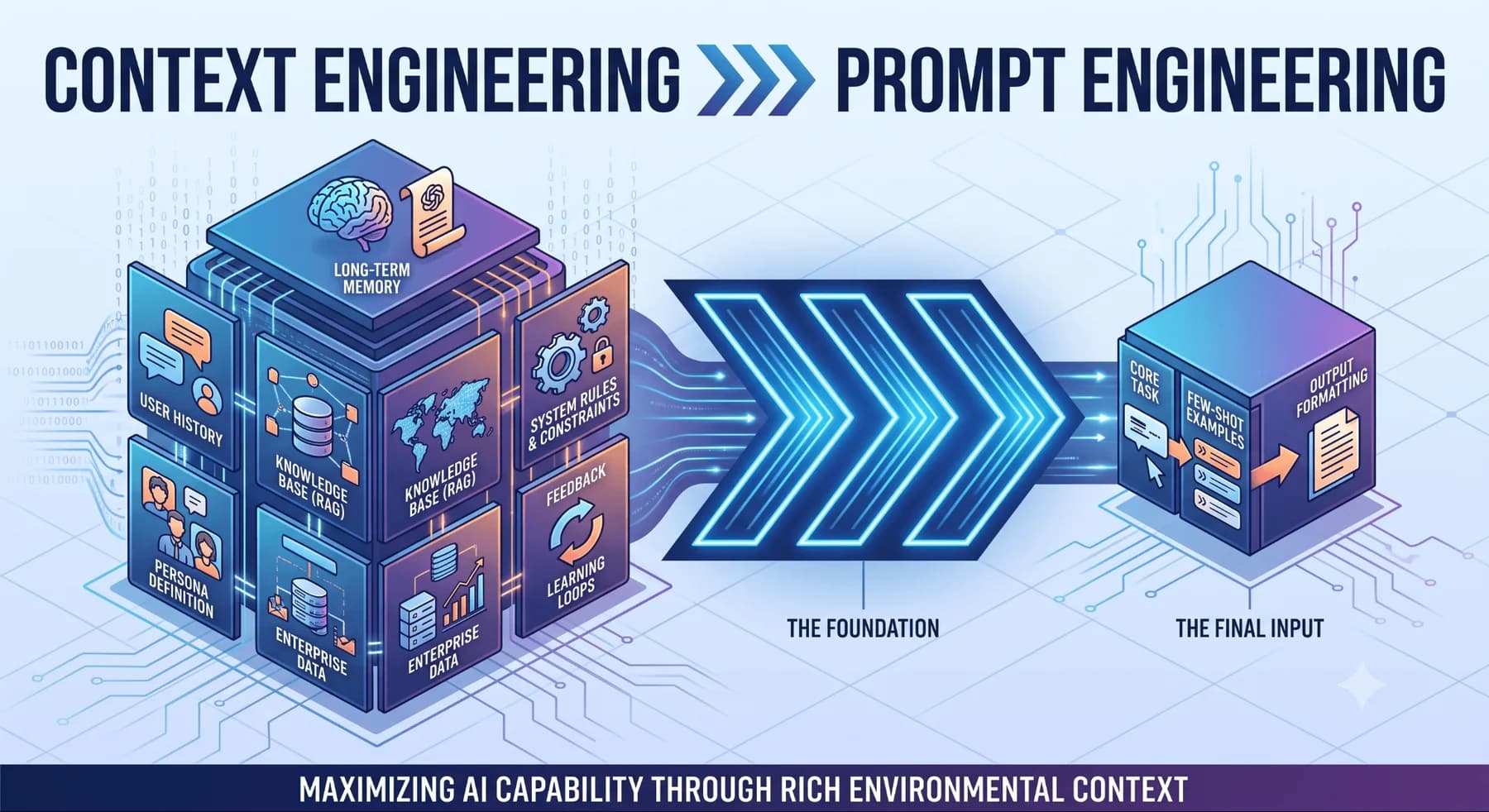
The next frontier in agentic AI is not bigger models. It’s better orchestration, governance, and integration with the rest of the enterprise.
Workflow decomposition is becoming the primary engineering activity. The teams who win will be the teams who can decompose complex business workflows cleanly into deterministic and probabilistic stages, then compile them into stateful graphs that run reliably and economically.
Integration depth is the second frontier. Stand-alone agents look like prototypes. Agents woven into the operational fabric of the business are where durable value compounds.
Long-lived infrastructure is the third. Enterprises that treat agentic AI as a multi-year platform investment — with the same discipline applied to databases or container infrastructure — will have a structural advantage over those treating it as a sequence of one-off projects.
The Three Things to Remember
1. LangGraph is a platform primitive, not a library. Treating it as shared substrate across the agent portfolio is what lets enterprises scale agentic AI economically.
2. Cost discipline compounds. Idempotent recompute, per-node model routing, and structured-output discipline applied consistently across agents are the difference between scaling and surprise.
3. Replayability is the governance foundation. Immutable persistence, prompt versioning, and end-to-end tracing turn audit questions into definitive answers. Build these foundations early.
This concludes our 3-part series. If you missed the earlier pieces, Part 1 covers why most LLM projects stall before production and the engineering case for orchestration, and Part 2 goes deep on the production engineering disciplines — memory partitioning, retrieval, structured outputs, guardrails, and observability — that keep multi-agent LangGraph systems reliable (https://bigsteptech.com/blog/langgraph-multi-agent-production).
Frequently Asked Questions
How do we know when our organization needs an enterprise AI agent platform?
Three signals usually appear together: multiple teams building production agents independently, operational concerns (observability, cost monitoring, governance) duplicated and inconsistent across teams, and a new requirement that needs cross-agent state or capability sharing.
When two of the three are present, the inflection has arrived. The cost of moving to a platform model is significantly lower than the cost of waiting another year.
Should the AI platform be owned centrally or distributed across teams?
A small central team owning the platform substrate works best, with product teams owning the agents themselves.
Centralizing too much creates throughput bottlenecks; decentralizing too much creates inconsistency and duplication. The platform team’s job is to make agent development easier for product teams, not to gate it.
What is the single highest-leverage architectural decision at this stage?
Standardize on a shared orchestration runtime (LangGraph or equivalent) and a shared observability backend before building the next agent.
These two decisions, made early, prevent most of the fragmentation problems that drive costly re architectures eighteen months later. Everything else can be added incrementally.
How do we handle the multi-vendor model question at enterprise scale?
The LLM gateway is the right place to abstract this. Agents specify capabilities they need (reasoning depth, structured-output reliability, cost ceiling, latency budget); the gateway routes to the appropriate model.
When models change, agents do not. This pattern also enables shadow comparisons between providers on the same workload — which is how serious capability-versus-cost evaluation gets done.
What does migration to a unified platform actually look like?
Incremental, not big-bang. Stand up the platform substrate alongside existing agents. Migrate one agent at a time, prioritizing the ones with the most operational pain or highest cost.
Each migration is a short engagement, not a multi-quarter rewrite. By the time a few agents have moved, the value of the substrate is visible enough that remaining migrations become straightforward.
Designing Your Enterprise AI Architecture?
If your organization is approaching the platform inflection — multiple agentic systems in production, fragmented infrastructure, mounting cost or governance pressure — we would be glad to help.
The BigStep AI engineering team partners with enterprises to design and build the orchestration, observability, and governance substrate that turns a portfolio of AI projects into long-lived platform infrastructure.
Get in touch with our AI engineering team → Contact us