
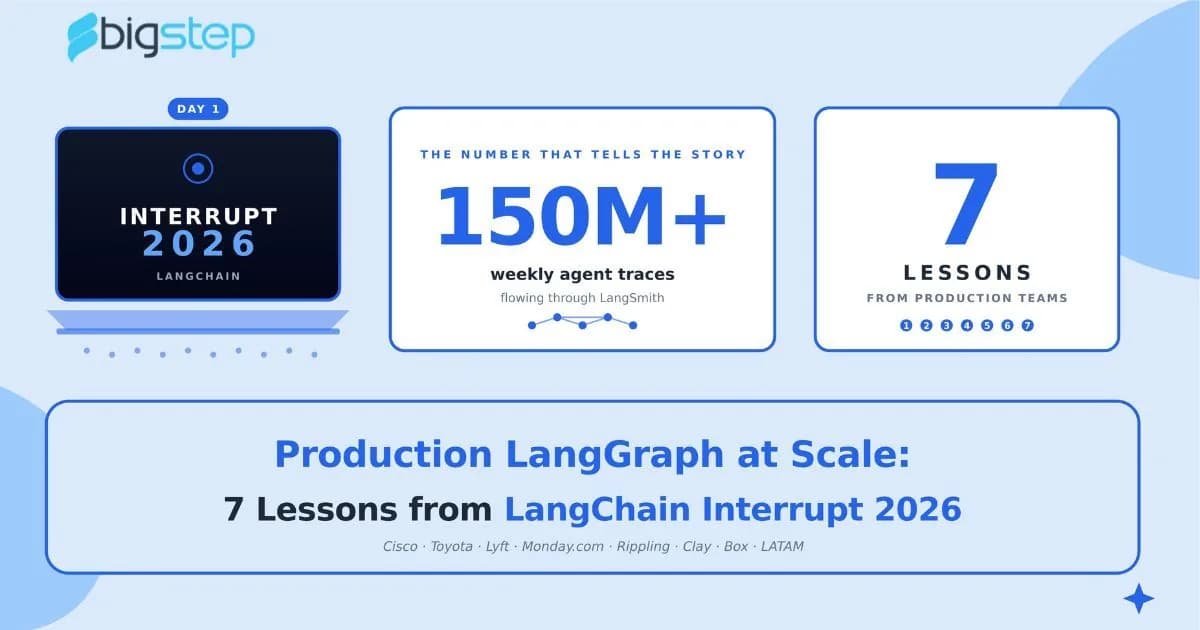
How Cisco, Toyota, Lyft, Rippling, and others are building agentic systems that actually survive production
_Across Day 1 of LangChain Interrupt 2026, one number kept coming up: 150M+ weekly agent traces now flowing through LangSmith._
That single data point tells the story of the last twelve months better than any blog post, enterprise AI agents are no longer demos. They’re shipping.
At [BigStep Technologies](/), **we’ve spent 24 months building LangGraph systems for clients in insurance, FinTech, and ed-tech. Five are running in production today**. Day 1 at Interrupt confirmed seven patterns we’d been seeing and surfaced two we hadn’t. Here’s the field report.
1. The shift from “agent” to “agent harness”
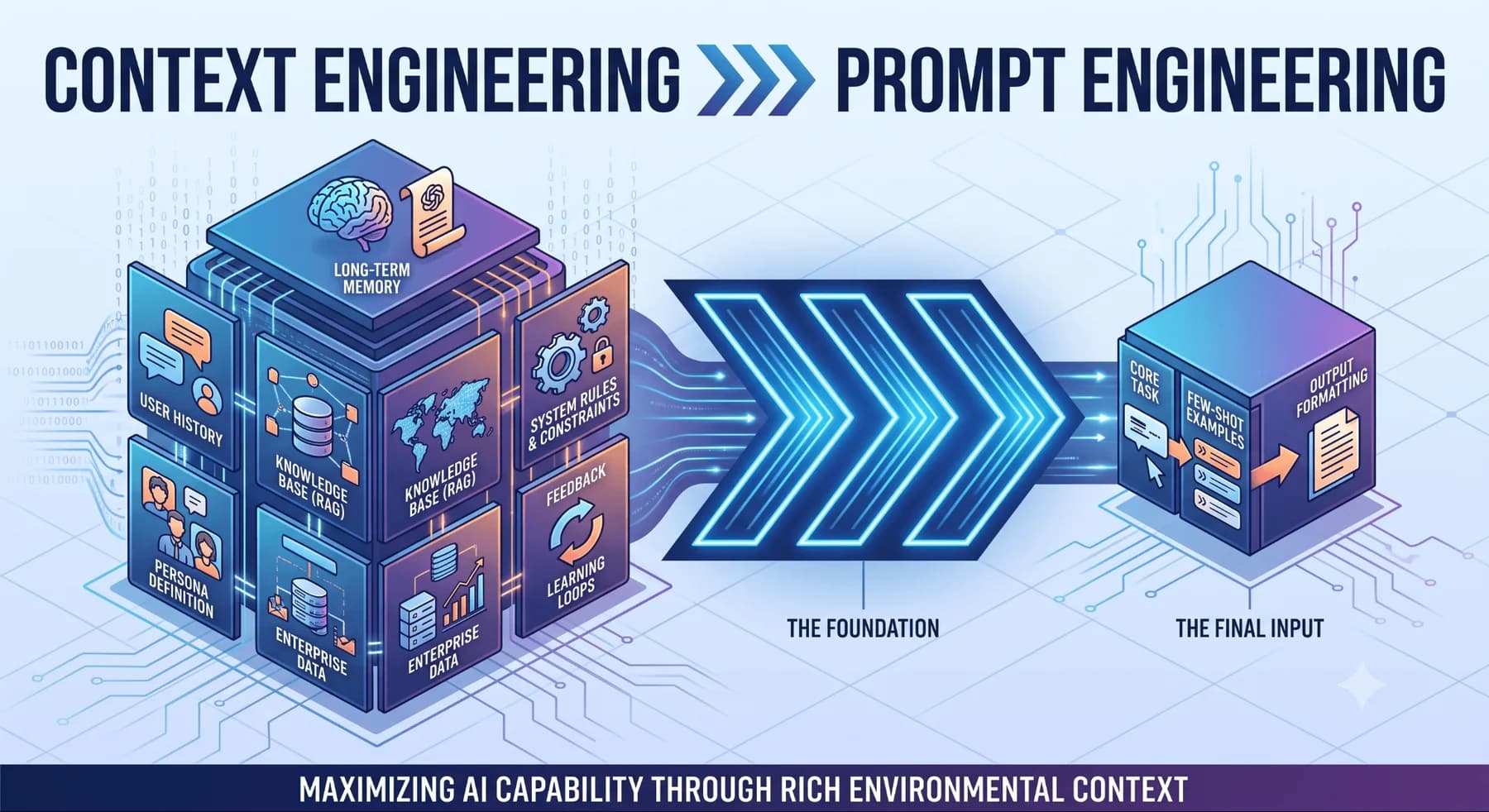
Harrison Chase’s keynote framing was sharp: an agent is a model in a loop. An agent harness is everything around it, sandbox execution, context management, human-in-the-loop steering, sub-agent delegation.
DeepAgents 0.6 packages these natively. For our LangGraph deployments at BigStep, this isn’t theoretical; every system we’ve shipped over the last 18 months has needed all four. What’s new is you no longer have to build them from scratch.
Worth bookmarking → [Why 2026 Is the Year SaaS Becomes Agentic](/blog/ai-native-enterprise-agentic-workflows-2026)
2. Supervisor agents should stay lean
Carlos at Cisco runs a multi-agent system managing $26B+ in recurring revenue. His top architectural lesson: keep the supervisor lean.
Metadata, policy, routing only not thousands of lines of business logic. When supervisors get fat, planning fails, replanning fails, debugging becomes impossible. We’ve made the same call on every BigStep LangGraph deployment: thin supervisor, fat specialists.
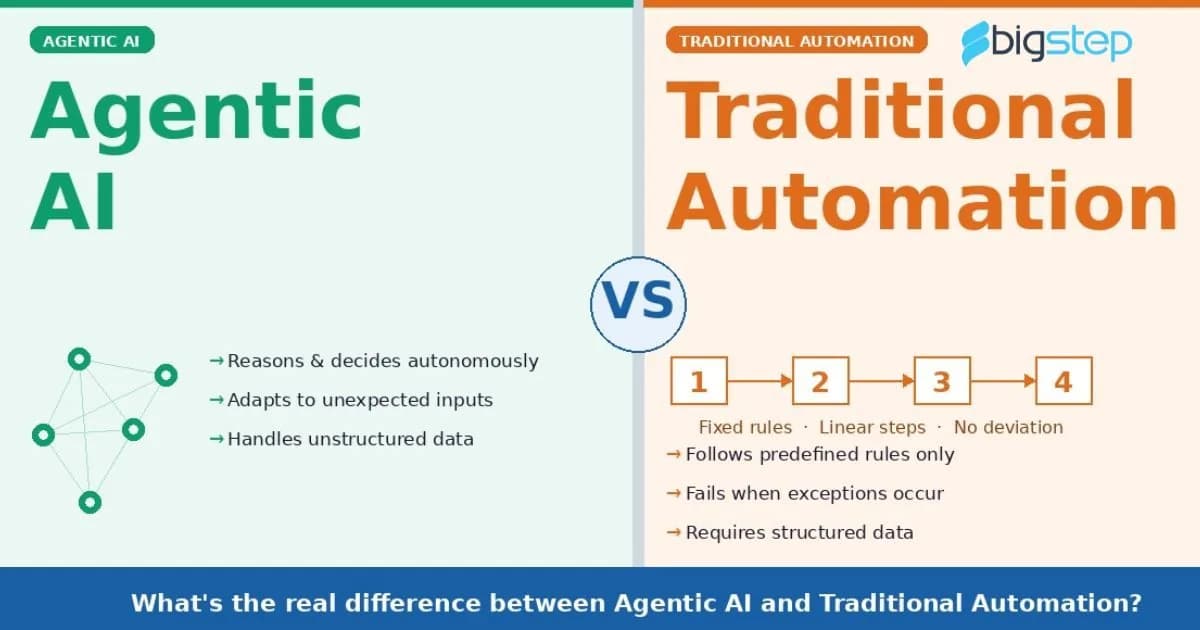
3. Deterministic commands beat LLM creativity on business-critical paths
Another Cisco insight worth its own section: “backslash commands” like /qbr or /write_model run as deterministic workflows with zero LLM interpretation.
The team learned the hard way that letting models freelance on revenue-critical operations is too risky. The pattern: LLM for reasoning, deterministic code for execution. It’s the architecture we’ve adopted at BigStep across all regulated-industry deployments.
4. Flat agents are winning over hierarchical ones
Rippling moved from hierarchical multi-agent → flat single agent with declarative skills. Monday.com’s v2 tried 400+ tools across domains and failed spectacularly.
The lesson: as models improve, complex orchestration adds overhead without proportional gain. Flat architectures with composable tools and clear domain context let the model do the reasoning. This is the inverse of 2024’s conventional wisdom, and Day 1 made it a consensus.
5. Self-healing is no longer optional
Monday.com reported a 94% recovery success rate from agent failures via their self-healing middleware. Clay built a TCP-style backpressure system that delivered 4–10x throughput improvement.
Cisco invested in self-correction at every layer. The pattern: in production, agents will fail. The systems that survive are designed to recover automatically. We’ve been telling clients this for two years at BigStep — Day 1 made it consensus across the field.
6. Evaluation-driven development is the new TDD
Rippling’s “evals first and win” framing crystallized something most teams still miss: a single passing test isn’t 100% reliability. 1/1 = 20% lower bound on a 95% confidence interval. 3/3 = 44% lower bound.
You need statistical rigor on agent evaluations, not “it worked once in dev.” Lyft built an entire offline simulator (inspired by SWE-bench) because they can’t use customers as test subjects. This is where most enterprise AI teams will spend the next 18 months catching up.
Worth bookmarking → Why Most LLM Projects Stall Before Production.
7. Code as the universal agent primitive
Box’s argument: agents are always better at code than at any other task. Monday.com’s takeaway: replace hundreds of specific tools with code generation. Cisco combines traditional ML for what ML does well (95% accuracy on risk prediction) with LLMs for reasoning.
The agentic stack of 2027 will look like: foundational tools + code sandbox + domain expertise. We’ve built our last three BigStep deployments this way.
The pattern threading through all sessions
_Every team — Cisco, Toyota, Clay, Monday.com, Lyft, LATAM, Rippling — described the same arc: built a v1 with the obvious architecture, it broke, they learned the same expensive lessons._
Their v2 (or v3) now looks remarkably similar: thin supervisors, composable tools, code sandboxes, self-healing, statistical evals, deterministic paths for business-critical flows. If you’re starting now, you don’t have to learn it the way they did.
What BigStep is taking back to client work
Three concrete things we’re already implementing across our LangGraph deployments:
- Backslash-command patterns for deterministic business workflows in regulated industries
- Statistical evaluation frameworks with confidence intervals on agent reliability claims
- Flat agent + code sandbox architectures for clients moving from pilot to scale
Day 2 has more on context engineering, orchestration patterns, and the production AI economy.
Practical Production Use Cases
The Interrupt recap also grounded these patterns in simple, repeatable use cases.
- Customer support copilots: Lyft‑style agents that resolve rider or customer issues by combining retrieval, internal tools, and clear human‑handoff rules—ideal for a thin supervisor plus a flat LangGraph agent.
- Revenue and account teammates: Cisco/Rippling‑style agents that surface risks, prep QBRs, and answer account questions, while deterministic flows handle any changes to revenue systems.
- Knowledge copilots over messy data: Toyota, Box, and LATAM‑style agents that sit on top of PDFs, CAD files, logs, and transcripts using LangChain/LangGraph, Context Hub, and vector search to answer questions and suggest actions.langchain+1
At BigStep, these three patterns—support, revenue, and knowledge copilots—have been the fastest on‑ramp from “pilot” to “production” with LangGraph.
Get the complete breakdown → [LangGraph case study](/company/case-studies/ai-agent-location-intelligence)!
Frequently Asked Questions
What is LangGraph and how is it different from LangChain? LangChain is the broader framework for building LLM applications. LangGraph is the orchestration library for stateful, multi-step agent workflows — where most production agentic systems actually live.
What’s the difference between an agent and an “agent harness”? An agent is an LLM running in a loop calling tools. An agent harness is the surrounding infrastructure that makes agents work in production: sandbox execution, context management, human-in-the-loop controls, sub-agent delegation, observability. DeepAgents 0.6 launched at Interrupt 2026 as a batteries-included harness.
Why are teams moving from hierarchical to flat agent architectures? As underlying models improve, complex orchestration adds overhead without proportional gain. Flat architectures with strong tool composition and clear domain context let the model do the reasoning directly.
Rippling and Monday.com both reported this shift on Day 1.
What does “self-healing” mean for agent systems? Automatic recovery from agent failures — failed API calls, timeouts, tool errors, hallucinations. Monday.com reported 94% recovery success through advisory tools, resource scaling, and automatic retries built into their middleware layer.
How does BigStep Technologies work with companies building production LangGraph systems? BigStep has been building production-grade LangGraph and multi-agent systems for B2B SaaS companies for 24 months — five live deployments across insurance, FinTech, and ed-tech. We work with founders, CTOs, and engineering leaders on agent architecture, evaluation frameworks, and reliability engineering.
Get in touch with our AI engineering team → https://www.bigsteptech.com/contact-us/